Start your claim now

Suffering Injury At Work

Knowing what to do after a workplace injury can help you to reduce the stress and confusion of what comes next. Workplace injuries are unfortunately common, and if you have become involved with one that affects your health, then you may be entitled to make a work accident compensation claim.

With any injury at work, there are a clear set of steps that you need to take to ensure that your recovery is more rapid. There is a clear ladder of succession when it comes to who to turn to, and by following these steps you make your chances of making a successful injury at work claim more likely.

Speak To Colleagues

Your first step after an injury at work is to ensure that you have received the correct medical attention. Your first step should be to inform your colleagues of the accident and seek out the designated first aider on the premises. This will be an essential stage when it comes to your recovery. The sooner that you receive medical help, the better.

Speaking to your colleagues will also make them aware of the circumstances of your injury and reduce the chances of the same thing happening to them. This will also help form the foundation of your injury at work claim.

Report the Incident to Management

Speaking to your manager will be the next step. If your injury is serious, then they have a legal obligation to inform the Health and Safety Executive. In many companies, failing to report the accident can be a dismissible offence, so make sure that you do so. At this point, focus more on ensuring that the accident isn’t repeated, and do not discuss the notion of blame. Fault is a difficult element of an injury at work claim, and by raising the subject now, you may end up making it harder to move forward. However, you need to ensure that your accident has been recorded in the accident report book. It may also be useful to take any photos of the environment where the accident occurred, as well as any injuries that you have received.

Medical Professionals

If you are considering making a work accident compensation claim, then you will need to compile evidence. Keep any records of visits to your GP or the hospital. These will be essential if you decide to make a grievance. You should also consider keeping a diary of your symptoms as well, as this will help both your legal team and your doctor. Bear in mind that if you only visit your doctor once, then your payment will be affected. An injury at work claim is decided by the effects of the injury, and the more severe it is, the higher your compensation will be. If you have issues with pain or quality of life, then take the time to visit your GP.

Being involved in a work-related injury will always take you by surprise. Managing and coping in both the long and short-term will be far easier if you follow these guidelines. Speak to a legal professional who has experience with injury at work cases, and you could be receiving monetary compensation that will make your recovery much more manageable.

Stress in the workplace can have a number of significant negative effects. These range from a lack of productivity to mental health issues and can be caused by a variety of influences. These include:

  • Excessive workloads
  • Toxic co-workers
  • Angry customers
  • Commutes
  • Dangerous work conditions

Reduced productivity is the first major sign of workplace stress, and may result in you taking your stresses home with you. That creates a cycle of stress that means that you have no respite. Dealing with workplace stress can be challenging, but work-related stress compensation is possible. Here’s how workplace stress can affect your productivity, and what you should do to tackle these issues.

Time Management Problems

One of the problems with workplace stress is that it can make your work faster than you can perform. This is due to the adrenaline burst that comes with excessive stress. A combination of frustration and panic can lead to mistakes being made, which will affect your overall productivity. This source of stress can lead to many negative consequences, but the most prevalent is the rise of workplace resentment. This too will lead to a lack of productivity, as you will be feeling unappreciated by your employers.

Relationship Strain

It’s not just your relationships with your colleagues that will be affected by excessive stress. Your personal relationships can suffer as well. The feeling of hopelessness caused by a lack of peer support in the workplace or an excessive workload can lead to depression, heightened sensitivity to even the most constructive criticism, and even paranoia. This can result in arguments, as well as a reduction in your own personal self-esteem. This will lead to less focus on your work, reducing your productivity and creating a cycle that can be hard to break free from.

Information Awareness

Being stressed makes it difficult to retain information, and can also cause a lack of focus. Stress is mentally exhausting, and if you are given new work guidelines or tasks, it can be difficult to retain the required information. The lack of focus will mean that you are more prone to accidents or mistakes, which will diminish your productivity even more.

Health Issues

Stress can cause a number of noticeable health problems. Those health problems will mean that you are not working at 100%, and your productivity can be dramatically affected. Symptoms of stress-related health issues include:

  • Headaches
  • Insomnia
  • Blurred vision
  • Weight fluctuations
  • High blood pressure

There are many more potential health problems that can be caused by stress, and you will need recovery time. A work-related stress compensation payment can help you if you need to take time off work to recover from excessive stress.

Your employer has a set of legal guidelines that dictate how they deal with cases of work-related stress. If you think that you have a valid issue that fits with the guidelines of stress at work claims, then you may be entitled to compensation. Whether you receive a payment for general damages or special damages will depend on your individual case, but will reflect the amount of work-related stress compensation that you ultimately receive.

Injury RecoveryInjuries and accidents can strike at any time. Knowing the best ways to recover can have a drastic effect on the amount of time that it takes to get back to full health. There are some simple steps that you can take that will help you to not only speed up your recovery time but also make it easier to get injury compensation if someone else was the cause of your injury. If you have been injured at work or in your personal time, then here are the best actions that you can take that can help you recover and regain your pre-injury quality of life.

Be Patient

It can take time to recover from an injury. The time that it is likely to take will depend on the severity of the injury. Your doctor will have given you some estimation on recovery time, and you should try to stick to those guidelines as much as possible. Trying to rush your recovery can lead to complications, and may even make your injury worse. Take time to heal, and use that time productively. If you are considering personal injury claims, then you should use your healing time to gather as much information about the causes of your injury as possible.

Light Exercise

Your doctor will have advised you about the need to keep moving. If your injury does not affect mobility then something as simple as a daily brisk walk can be highly beneficial and could help to reduce the time it takes to recover. If mobility is an issue after your injury, then speak to your doctor about the best ways to keep your fitness levels acceptable. Never try and over-exercise. You might think that pushing your muscles to pre-injury levels will speed up your recovery, but it’s more likely to cause additional damage.

Eat Well

Eating healthily is always a good idea, but when you’re recovering from an injury, it becomes essential. Eating the right foods can speed up the time it takes to regain your health. Ideally, you want to focus on protein-rich foods, as well as fruits that are high in Vitamin C. Speak to your doctor and they will be able to provide you with a list of the best foods to include in your diet. Eating the right food can help your body to rebuild while eating the wrong food types can result in a much slower recovery time.

Legal Advice

If your injury was the fault of someone else, then you should use your recovery period to look at personal injury claims. Look for a solicitor that has experience with injury compensation, as there may be medical terms that can be confusing for those legal experts who have never undertaken any form of a medical claim. If your injury has caused you a massive drop in the quality of your life, then making an injury claim could help you pay for any changes to your life or home that may be the result of your injury.

Recovering from an injury will take time and patience. Take your time to recover, and look for practical ways to speed up your recovery. If you suffer from financial concerns due to your injury, then an injury compensation payment could help to alleviate your worries.

Industrial WorkplaceOver the last four decades, cases of workplace accidents and deaths have seen a significant drop. This is largely due to improvements in health and safety guidelines, as well as an intense focus on safety practices by organisations.

In an industrial setting, worker safety is of paramount importance, as the variety of large, complex, and potentially dangerous machinery and practices is significantly higher than office environments. There are some key safety practices that should be adhered to by any industrial workplace, as these will help to reduce the potential for having to pay out any industrial injury compensation.

If you want to make your workplace safer, then here are the six safety practices to focus on.

1: Identify Likely Issues – There are going to be some areas of your industrial workplace that are more high risk than others. Make sure that these are looked at with the intention of minimising risk. Pay special care to identify the small injuries that may be more common and easily avoidable.

2: Involve Employees – By getting your workforce involved in any safety planning you will be able to benefit from their ground-floor experience. You will also make it easier for those employees to be more aware of potential issues and reduce your vulnerability to industrial injuries compensation.

3: Signage – You want your team to have visible and easy-to-understand signage that highlights potential dangers. These may need to be reviewed on a regular basis.

4: Stay Tidy – Make it a priority to ensure that there is nothing in the workplace that doesn’t need to be there. Clutter can be one of the main causes of workplace injury, and by removing the unnecessary, you will also promote greater productivity.

5: Machinery Maintenance – Industrial workplaces usually have an abundance of complicated and heavy machinery. Allocating regular times to clean and check them for problems means that you are tackling issues before they result in an industrial injury compensation payment.

6: Review your Safety Guidelines – This needs to be done at least once every year. Inspect your entire workplace alongside your team. Conduct a thorough review and update your safety guidelines where you identify new risks or issues.

Knowing the Risks

Some of the most common injuries in an industrial workplace will require awareness if your goal is to reduce your exposure to injuries. Some of the most common workplace injuries in the industrial sector include:

  • Falls
  • Falling materials or objects
  • Breathing issues
  • Injuries caused by vehicles
  • Electrical accidents including electrocution
  • Accidents involving ladders
  • Machinery accidents

The key to keeping your instances of workplace injury to a minimum are staff training, diligence, and essential safety equipment.

Workplace injuries can drastically affect the lives and futures of your workers. From a business owners perspective, accidents in the workplace can interrupt workflow and negatively affect profit generation, as well as exposing you to the financial risks of a high industrial injuries compensation payment. If you want to limit your exposure to these risks, then creating a culture of safety in your industrial workplace is essential.

Hearing LossEveryone reacts differently when it comes to a change in their ability to hear. The emotional response can lead to anger and vulnerability. Knowing your rights if you suffer from any form of hearing loss can help you when it comes to making a case for hearing loss compensation.

There are practical steps that you should take that will not only help you understand the causes of what’s happening with your hearing but also let you know how likely your case is for hearing loss claims. The earlier that you address your hearing loss, the easier the problems can be tackled, and knowing your rights will be the key to living with your hearing issues.

Medical Treatment

Your first step once you have identified an issue with your hearing should be to seek professional treatment. Take a hearing test, and make sure that it is in person. There are a variety of online hearing tests available, but these are unreliable and should only be used to clarify that you have an issue. Professional medical treatment will make any hearing loss claims easier to resolve.

Workplace Hearing Loss

There are some work roles that are more vulnerable to the risks of hearing loss. These roles are often consistently loud work environments, and include:

  • Sound engineers
  • Mining
  • Shipyards
  • Construction

However, nightclub workers and other roles that tend to take place in environments that are loud can cause hearing damage. If your workplace has affected your hearing, then you will have three years to make your hearing loss claim.

Date of Knowledge

This is a term that covers most medical compensation claims. The Date of Knowledge will usually be three years after the date that you were exposed to the noise that caused your hearing loss, although there are factors that may be taken into account if you have taken longer than three years to make your hearing loss claims. Date of Knowledge can also be counted as the date on which you discover that you have a hearing impairment.

Employer Liability

All employers have a duty of care, and that covers the volume of noise that workers are exposed to. Health and Safety legislation sets clear guidelines and rules for noise volume under the Control of Noise at Work Regulations 2005. This piece of legislation was designed to protect the hearing health of employees. If your employer has not conducted a thorough assessment of noise volume in your workplace then you will be able to make a claim for hearing loss compensation. The measures that employers must take in loud work environments must include:

  • The installation of sound barriers
  • The use of materials that will absorb sound
  • Shorter work time exposure to loud working environments
  • The provision of protective equipment for those employees that work consistently or intermittently in loud

If your employer has not adopted these measure, then you may be entitled to apply for hearing loss compensation.

There are clear legal rights that are in place to protect the hearing of employees. If you feel that you have suffered from hearing loss as a result of workplace flaws, then you should contact a legal team as quickly as possible. The quicker that you take action, the easier hearing loss claims will be. Hearing loss can be stressful, and any financial compensation that you receive could help to pay medical expenses or remove the pressures caused by your hearing issues.

Food PoisoningThere are many different types of food poisoning. Each variation may have similar symptoms, although the time that you feel the effects of it can vary wildly. This is largely due to the type of food that caused that poisoning, how much was consumed, and how severe your symptoms are.

Typically, food poisoning only goes on for one or two days, and you may not even need medical care during this time. Whether it was through ingestion of food bacteria, viruses, chemicals, parasites, or even metals, food poisoning can affect not just the stomach, but other organs in the body as well.

If you’ve been affected by food poisoning it can be worrying, and you may not be sure how to respond. Here’s what you need to know.

Identify the Food Poisoning

It can take anything from an hour to a few weeks for the symptoms of food poisoning to become noticeable. This large time frame can make it tricky to identify when you have been affected by a case of food poisoning. However, the most common types of food poisoning are usually identifiable between two and six hours after eating any form of contaminated food. The symptoms to look out for are:

  • Diarrhoea
  • Vomiting
  • Pain in the abdomen
  • Nausea
  • Intense headaches
  • High temperatures

Other, less common symptoms can also include:

  • Blood or mucus in your stool
  • Dehydration
  • Aching muscles
  • Itchiness
  • Blurred or double vision

Identifying that you have food poisoning is the key to knowing your next steps.

Treating Food Poisoning

Usually, the best thing that you can do if you have been hit by food poisoning is to keep yourself hydrated. If you are vomiting or you have diarrhoea, then you should try and drink water as soon as possible. Often, it can take a few hours before you feel comfortable doing so, and you should avoid food if you are feeling nauseous. Ice chips can be a useful way of rehydrating. If you feel that your food might stay down, then start with some plain options:

  • Rice
  • Plain toast
  • Crackers
  • Bananas
  • Cereal

There are some foods and drinks that you should try and avoid. These include:

  • Fizzy, carbonated drinks
  • Caffeine
  • Dairy
  • Overly fatty foods
  • Alcohol

However, your main priority should be rest. Your body is going to take time to recover, and the more rest that you get, the quicker your symptoms will fade.

Do You Need a Doctor?

There are some people that should always contact a medical professional as soon as they show signs of food poisoning. These demographics are:

  • Anyone older than 60
  • Babies and toddlers
  • Pregnant women
  • Anyone with a history of a weak immune system
  • People with existing health issues such as diabetes

Even if you do not fall under any of the categories, you should contact your doctor if you identify any of these symptoms:

  • If your symptoms last more than two days
  • Blood in your vomit or stool
  • Excessively high fever
  • A tingling sensation in your arms, or general muscle weakness

Can You Make a Claim?

Some of the effects of severe food poisoning can affect people for the rest of their lives. If you or someone you know has been affected by food poisoning that was caused by the negligence of someone else, such as a restaurant, hotel, supermarket, or cafe, then compensation could be possible.

All cases of food poisoning have their variations, but there are some guidelines for the amount of food poisoning compensation that you might receive:

  • Severe Cases – Between £27,450 and £37,500. This is for those people who have suffered from the excessive symptoms that come with severe food poisoning.
  • Short-lived Cases – Even the most serious instances of food poisoning can often last just a few days. The amount that you may receive when making food poisoning claims will depend on the severity of those symptoms. Excessive symptoms or effects such as no longer enjoying food or sex will be taken into account, and the food poisoning compensation bracket for this category will be between £6,850 and £13,700.
  • Discomfort Cases – Your solicitor will need to ascertain the severity of your symptoms. If you had a hospital admission due to severe stomach cramps or a loss of bowel function, then you can expect to receive between £2,800 and £6,850.
  • Minor Cases – Although food poisoning can be serious, it is sometimes nothing more than an inconvenience. The duration of that inconvenience will be important for working out your food poisoning claims. Potential compensation in these cases will be between £650 and £2,800.

Making a claim for food poisoning that has been caused by negligence will always be dependant on the causes and the effects. If you have suffered from food poisoning and your life has been negatively impacted in any way, then it’s worth seeking legal advice. The food poisoning compensation that you receive could help ease you back into full health.

Accident ClaimsAccidents can happen at any time and anywhere. How you react in the aftermath of an accident will have an impact on your recovery. Knowing the right steps to take in the immediate and long-term moments that follow any injury will determine your overall recovery time, and can also have an effect on any accident compensation claims you may be entitled to.

Having an awareness of the right steps to take will make it far easier to take those actions should the worst happen. If you’re not sure what steps you ought to take after an accident, then this guide will provide the answers.

Get Medical Help

This is by far the most important step that you need to take. The seriousness of your injury will dictate the remainder of the actions that you take, but no matter how serious your injury is, make sure that you get looked at by a medical professional. Some symptoms of your injury may not be apparent, and shock alone can have some negative consequences.

If you are involved in a serious incident, then call 999. This will mean that both the police and the paramedics will be immediately involved in the next steps.

Police Awareness

The authorities will want to know the details of how the accident occurred. If there are any arrests to be made, this is where they may happen, although medical attention is always going to be the priority. The police will launch their investigation if there is the potential for fault on anyone involved. Drunk driving accidents or injuries in the workplace may need to be investigated.

Gathering Information

A police report will be filed, and if you’re looking to claim any accident compensation claims, then you will need a copy of this at some point. In the immediate aftermath of an accident or injury, it can be difficult to focus on the essentials.

Try to make sure that you accumulate as much information about your accident as possible. Make sure that you take note of the circumstances of the accident, the names and contact details of those involved, and any other information that you feel is relevant to your case. If you have a working camera on your phone take photos of your injuries and of the scene of the accident.

Contact Your Insurance Company

If your injury is covered by any of your existing insurance policies, now is the time to contact them. This is where the information that you gathered will be of use. You may also want to contact an accident claim expert if you believe that you may be entitled to some form of compensation. Accident claims can be very straightforward, and you may find that any accident compensation UK that you receive can help to aid you through your recovery. Compensation can help to pay for any short or long-term consequences of your accident.

Accidents vary in severity, but even minor injuries can have a negative impact on your life. Make certain that you follow these steps should you be involved in any kind of accident, and both your recovery time and your potential for making accident compensation claims will be improved.

Failing to follow these guidelines could result in ongoing medical issues or the loss of any potential compensation that you may have otherwise received.

Cycling AccidentsAt the start of every year, gyms and roads across Britain become littered with people jogging, cycling and generally trying to get fit, and 2019 is no different. Over the last couple of years, cycling has become an increasingly popular way to keep fit and commute to work. The reason behind this is most likely the awareness around becoming a greener nation and the success of our cycling teams and riders; however, many people seem to forget that it can be very dangerous if you do not take the proper precautions.

Recent statistics show that there are around 18,000 cycling accidents on our road every year, which is very low compared to car traffic collisions. However, these statistics also show that cycling accidents are far more serious than car accidents. A report by The Royal Society for the Prevention of Accidents has revealed that per billion vehicle miles, 1,011 pedal cyclists are killed or seriously injured, in comparison to 26 car drivers.

Perhaps the most surprising fact to come out of the report was that you are more likely to be involved in a cycling accident during the day than in the evening, with 80% occurring in daylight. There are probably many reasons for this – busier roads during the day, more urgency to be somewhere ie. work and maybe due to many cyclists’ efficiency to wear high vis equipment and lights, which make it far safer in the evenings.

What can you do if you have been in a cycling accident?

If you have been involved in a cycling accident, whether it be with a car, pedestrian or another cyclist, the experience can be very traumatic. The last thing on your mind may be thinking about claiming compensation, however, there are measures you can take in case you want to make a claim later down the line.

Firstly, if you are in a fit enough state, you may want to make a note of the incident in as much detail as possible. Modern-day smartphones all contain note-takers so try and put down everything you remember about the accident, this will help later down the line if there are any points of dispute in your claim. You will also want to note down the names and contact details of anyone involved, including registration numbers if possible.

Another brilliant thing about modern technology is the quality of cameras on our phones. Not everyone has a dash camera, and more often than not you won’t be wearing a helmet or body mounted camera, so collecting pictures of the damage to bikes, cars or any other vehicles can be beneficial. If you have any visible injuries, it is worth trying to get pictures of these too.

How to claim compensation for a cycling accident

If you are confident that someone else is to blame for an accident that you have been involved in, you may have a valid claim for compensation. Due to the statute of limitations, you have 3 years to bring a claim from when the incident first occurred, which gives you plenty of time to recover and deal with the more important things before instructing a solicitor.

On rare occasions, the person to blame (the defendant) may approach you with a monetary offer in order to settle a case before any legal proceedings have taken place, however, we would always advise against this. It is best to deal with all matters through a third party in order to protect yourself and make sure you are getting the best advice possible.

Speaking to experts

The Compensation Experts have years of experience dealing with injured cyclists and can advise you as to whether you have a valid claim, whilst putting you in touch with some of countries best traffic collision solicitors. Claiming can be a long and stressful process if you do not instruct the correct team, however, we deliver the service, expertise and care whilst delivering a swift resolution to your claim.

If you would like to speak with one of our team about an accident, why not get in touch on our Freephone number 0161 413 8765 or alternatively use one of our call back request forms found here.

A case of amputation negligence surrounds a winning claim for former Network Rail employee Alan Evans. Evans was almost killed by a Brighton-to-London train while working on what should have been a safe stretch of track. Nevertheless, because Network Rail ignored warnings, they’re out nearly a million pounds in compensation damages.

For Mr Evans, the true nature of those damages as a result of that ignorance may not be over.

Perilous incident because Network Rail ignored warnings

Mr Evans was leading a group of 12 engineers working to upgrade the tracks near Redhill. They were suffering from metal fatigue, and thus, at risk of causing a terrible rail accident. One member of the team was posted as a “lookout”, further down the line, alerting the rest of the workers to an oncoming train.

In short: when a lookout spots an oncoming train, he/she alerts other crew members. Subsequently, the crew takes shelter on the side of a 45-degree bank. Thus leaving a small but acceptable distance of 150cm between themselves and the train tracks.

However, in this instance, the layout of the work area means that the lookout took a position at a distance. Coupled with the small distance, that would give him less than 20 seconds to warn others of an oncoming train. Ultimately, a train travelling at 80mph struck Mr Evans, almost entirely destroying his shoulder.

Shoulder surgeries may not prevent amputation

With more than 20 surgeries on the shoulder, it’s still likely that Mr Evans’ right arm needs an amputation. Accordingly, compensation claims aren’t far from his mind, as he’s now unable to work.

Network Rail was ordered to pay £800K in fines regarding breaches of health and safety regulations. This is especially poignant to Mr Evans, too. He himself had raised concerns over the safety of the high-risk site before work began. However, Network Rail was somewhat dismissive in response, telling Mr Evans that management would look into it.

Lawyers at Guildford Crown Court state that it’s reasonable to do such work at night. This is because trains do not run along the Redhill stretch of the line at these hours. Thus removing the risk of a train hitting a worker. Yet again, Network Rail was negligent of the risks of this situation.

Their insistence on working during the day left workers vulnerable to unnecessary risk. Ergo, these conditions ultimately brought on Mr Evans’ injuries.

How we can help

Mr Evans’ case is not a unique one to The Compensation Experts’ team of legal experts. Above all, The Compensation Experts thrive on getting victims of personal injury the compensation they rightfully deserve. Regardless of where you live (be it Surrey, London or Bristol), we work with the nation’s leading law firms.

With the help of trustworthy guidance from injury experts with experience, you can make a claim for any of the following.

We do more than just personal injury claims in the UK, too. We also cover accidents that take place abroad. Additionally, the cover includes (but is not limited to):

A personal injury claim can also be made by a third party after a person dies, or on behalf of a minor.

Here at the Compensation Experts, we frequently hear from people who are injured as a result of defective and uneven pavements and roads with a pot hole. Though the majority of these injuries are bruises and sprains, some people, a pavement trip compensation claim can be life-altering.

It’s especially difficult for the vulnerable and elderly. In short, they are susceptible to sustaining truly painful breaks, fractures and even some head injuries. So successful pavement accident claims for a trip affect a wide range of age groups.

In practice, these negligence claims such as these are by and large defended by the local authorities. Therefore, it’s imperative that either you or someone on your behalf carries out a few simple tasks right away. By carrying these out, you’ll be in a far stronger position to have the proper amount of compensation awarded to you.

In short, you will need to photograph the following factors for road and pavement accident compensation claims.

What you need photographs of for a pavement trip compensation claim

1. Surrounding location where the trip occurs

Take photographs of the street and surrounding shops, properties and landmarks in the area in which the incident took place. Also, be sure to take pictures of road signs and make a note of the surrounding addresses.

2. More specifically, the actual pavement defect

Document the defect in relation to other objects such as trees, the kerb, a street corner or anything else. Then take some photographs of the defect from roughly three metres away.

Next, you will need some close-up photographs of the defect. Ideally, you’ll have rulers in the picture (one in a horizontal position, the other in a vertical). Then, simply record the measurements (length breadth and depth) of the defect if possible. Failing that, placing some large coins in the picture to give a sense of perspective.

As a rule: if the paving slab is at least 1″ higher or lower, you have a right to compensation.

Who you need to talk with

There are certain people (other than The Compensation Experts) that can also strengthen your case for pavement trip compensation claims.
A pavement trip compensation claim can be strengthened if you act quickly.

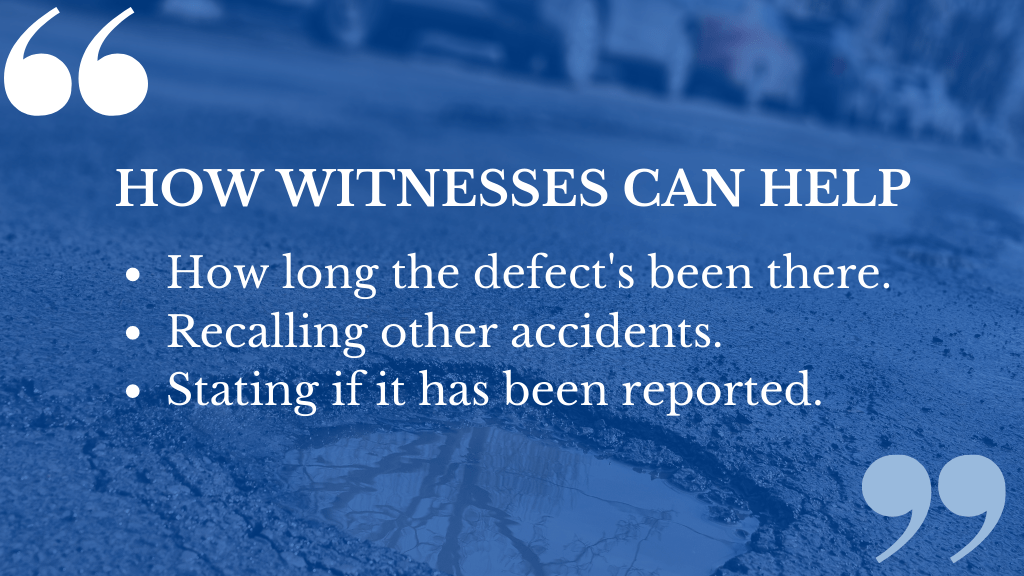
3. Witnesses to the accident for a pavement trip compensation claim

If it’s possible, talk to witnesses at the scene of the accident. Be sure to get their names and contact details: their testimony can significantly improve your case. Other people who regularly use the same street might vouch for certain specifics that can strengthen your case.

For instance:

  • They can state the length of time the defect has been there.
  • Also, they can recall any other previous accidents that took place at that spot.
  • Furthermore, they can state for the record whether or not the defect has been reported to the council.

4. Expert solicitors in a pavement trip compensation claim

It also stands to reason that an expert lawyer in pavement trips is a great way to support your case. Admittedly, we have a strong amount of bias on the matter in general. Nevertheless, at The Compensation Experts, we make it our business to know your case.

For instance, we give your accident the due diligence and expertise to determine if you can win.

Moreover, we work on a No Win, No Fee basis if you’re injured due to pavement trips and falls. That means when we become your personal injury solicitor, we believe in your case. Because we’ve done our homework and have enough confidence in your case.

Bottom line: we’re motivated to get you a successful claim for compensation for uneven surface tripping claims. So call us on 0800 182 2187 or fill out our Contact Form to set up a free consultation – you’ve no obligation.

5. Identifying the council to hold responsible for your claim

To date, you have the place, the lawyer and the witnesses to the pavement tripping accident on the record. So you next need to determine who you actually need to direct your claim at.

One great place to start is the Postcode Check for Pavement Compensation Claims on gov.uk. If you’ve tripped on a pavement and know the location, you can simply insert the postcode and see:

  • First, the Council that’s responsible for that area.
  • Second, that Council’s official website & department to handle your claim for personal injury compensation.

Sometimes, the boundaries for determining which council is responsible for that tripping hazard can be tricky. For example, you might be visiting friends in a certain part of London you’ve never been to before.

It’s a reminder, therefore, to act quickly to maintain the integrity and accuracy of your claim.

6. Land Owner

Certain conditions might dictate that the landowner is the point of contact. However, this is more likely for slips, trips or falls claims rather than pedestrian accident claims involving walking.

BONUS – The factors beyond your control

What you can’t directly control in these matters are:

  • Control of a council’s purse strings.
  • How weather affects the hazardous area in question.

Indeed, weather conditions alone aren’t the factor so much as budget concerns and the inability of councils to act quickly. But the problem almost unfailingly starts because of the environmental factors that make the hazard crop up. It could be a root from a tree under the pavement, or the salt councils spread over roads for snowstorms.

For instance, consider how a pot hole becomes a tripping hazard in the first place. These road hazards can build up over the long-term as a result of battering from inclement weather and heavy traffic. Yet until someone complains vociferously enough, councils may not know the extent of the problem.

But getting a hazard on the record still might not be enough to incite the council to act. Therefore, your personal injury claim gets stronger. Because the hazard was on the record, and yet the council didn’t act fast enough, meaning they failed to prevent your injury.

Conclusion

By carrying out these tasks you can:

  • Improve your case and;
  • Greatly increase the likelihood (and perhaps the size of) your compensation.

That money can then go some way to helping you recover from your injury. You can cover costs and any lost earnings as a result of the injury.

We count on it so much that it public transport accidents often fly under the radar. But they really shouldn’t, thanks in part to the number of people who use public transport regularly.

Every day, thousands of people in the UK use one form or another of public transport. They trust it for any number of reasons, either to:

  • commute to work;
  • visit family and friends;
  • do the weekly shopping, and/or;
  • perhaps just to leave the car behind and go for a drink.

Millions upon Billions of public transport journeys

Last year in the UK, we made 5.2 billion passenger journeys on buses and 240 million journeys on light rail systems. The breakup of national transport networks settles into fragments of private ownership. But the use of the railways has doubled since privatisation. Moreover, most judge it, by and large, to be a safe and effective way of getting around.

Although safety, in general, is a paramount element in supplying transport services, accidents do still happen. Fatalities are thankfully rare, but buses commonly feature in accidents. Although they might not make front-page news, they can still result in back, neck or other serious injuries.

Railway safety also has its share of injuries, albeit mostly minor in nature. For the last five years of Government ready statistics, there have been at least:

  • 6,000 annual minor injuries for train passengers.
  • Between 287 and 377 annual major injuries for passengers, plus;
  • There were 586 major injuries for all kinds of people on the rails in 2018-19 alone.

RTAs versus Public Transport Accidents

In the event of a personal injury resulting from a road traffic accident, liability gets tricky. Which is why it’s always advisable to contact a personal injury lawyer as soon after the incident as possible. The responsibility could lie with:

  • the driver;
  • the firm providing the service (in essence, the transport company);
  • another road user or;
  • the council who are responsible for road layouts and traffic lights.

We usually think of public transport accident injuries resulting from collisions, such as bus accidents. But other non-collision type injuries are more common than many would think. Slipping on wet floors of moving buses and trains is worryingly common, too. They can result in:

  • bruises;
  • fractures;
  • head injuries;
  • damage to personal belongings and;
  • the potential loss of earnings during a period of recovery.

Public transport accident: A Case Study

A case study of a passenger accident claim involves a man suffering an injury in a car crash. The cause of the crash itself, however, was another driver of the car in which he was travelling. Accordingly, the claimant suffers severe whiplash and is unable to work for three months while stuck in recovery.

As it turns out, the other driver has driver’s insurance. So we supply the relevant evidence to make a compensation claim (which includes police and medical reports). Accordingly, the driver’s insurance company acknowledges liability. And, as a result, the client receives almost £7,000 in damages.

Altering your life

These injuries are painful and debilitating to those unfortunate enough to fall victim to them. Medical treatments for public transport injuries may become necessary. Moreover, when you’re involved in an accident, it can significantly alter the course of your life. Be it the fault of a bus driver or whomever, any form of public transport has a duty of care to avoid accidents on public fares.

Say if your personal injury claim becomes a reality. In turn, a bus, train or tram accident can wreak havoc on you professionally. Therefore, you can claim for any and all loss of earnings when you:

  • Miss work;
  • Must alter your work schedule because of any injuries, or;
  • Need to change the work responsibilities you have as a result of the accidents. For instance, you work in a job where you’re on your feet and physically interactive. Subsequently, you need to switch to a desk job because the loss of mobility demands it.

What to do next?

Where you sustain injuries from avoidable circumstances, it’s imperative to seek justice. Moreover, the pursuit of a public transport accident claim can develop our ability as a society to do better.

Because through learning from these events, transport bodies can make necessary changes. In addition, these changes can mitigate the risk of such injuries happening again to someone else.

Your lawyer will build your case using relevant evidence to support your claim. For example:

  • Your medical records detailing your injuries and prognosis.
  • Reports from the police and other emergency services who respond.
  • Statements from any witnesses who see or hear your accident.
  • In addition, they might use photos or film footage of the accident site.

The time limit factor of a public transport accident

You can’t afford to dawdle, either, when it comes to public transport accidents and compensation claims. In truth, you have a three-year time limit from the date of the accident to file a claim.

Nevertheless, the sooner you act, the better your claim will turn out. Taking notes and getting your recollections, witnesses and specific relevant details down helps your case, too. With this now on the radar of your solicitor, we can help turn your injurious malady into a financial melody.

Contact us today if you feel that you need compensation for a public transport accident. Whether it causes an injury or does otherwise, we’re here to help. We use firms authorised and regulated by the Solicitors Regulation Authority (SRA) and are registered in England and Wales.

Justice Secretary Liz Truss promises car insurance premiums will fall as part of a Government crackdown on compensation culture. The Justice Secretary has out a consultation paper outlining plans to put a cap on compensation awards, or even ban whiplash claims altogether.

Whiplash claims are on the increase, with one made every minute in the UK. This has led to fears that a ‘cash for crash’ culture is developing. In essence, the government wants to counter claims that the UK is the ‘whiplash capital of the world’ amongst nations.

Road traffic accident claims have nearly tripled since 2006, rising to 770,000 in 2015. The average payout per claim in 2015 was £1,850.

Reasons for the whiplash claims crackdown

George Osborne made note of similar plans last year, before stepping down in the wake of:

  • the Brexit result and;
  • David Cameron’s resignation as PM.

The Justice Secretary’s proposals go further than Osborne’s. Accordingly, they will include a cap on the payments for more serious whiplash injuries. Claims will now:

  • top out at £1,100 for injuries that take a year to recover from, and;
  • £3,500 for injuries of longer duration.

Ms Truss also plans to implement Osborne’s plans to raise the threshold.

The Tories, in essence, don’t want small claims court to fill up with for personal injuries from £1,000 to £5,000. However, the consequence may well be that victims of genuine injury cannot seek redress. In effect, victims will be unable to afford the legal help they need to do so.

In a bid to tackle so-called ‘compensation culture’, we here at The Compensation Experts wonder. Is the Government removing the right of genuine claimants to seek justice and compensation from negligent drivers? All in order to just save car insurers money?

Need to beat the whiplash claims crackdown with an expert solicitor?

If you need to make a road traffic accident claim for personal injury, please contact us today to discuss your no win, no fee claim.