Start your claim now

A company has been fined after a worker suffered a fatal electrocution at work whilst operating a lorry mounted crane. The worker was fatally electrocuted when the crane he was operating struck an overhead powerline whilst he was unloading materials in a field at Cowbridge, South Glamorgan.

An investigation by the Health and Safety Executive (HSE) found that the employer had not done a risk assessment in the field where the incident happened. There were also no control measures in place to prevent contact with the overhead powerlines.

The company paid a fine of £160,000 and costs of £45,000.

Speaking after the hearing, a HSE inspector said: “This death was easily preventable, and the risk should have been identified.  Employers should make sure they properly assess and apply effective control measures to minimise the risk from striking overhead powerlines. This death would have been preventable had an effective system for managing unloading materials been in place.”

electrocution at work

Electrocution at Work

Electric shock accidents can occur when somebody comes into contact with an electrical current. This electrical energy flows through the body, causing a shock, which can result in burns, nerve damage, or even death. Some victims of electric shock have permanent scarring and limited mobility.

Electric shocks can also contribute to secondary injuries such as lacerations, fractures, and dislocations. This is because electric shocks can generate such a large amount of force that they can throw a victim off the ground.

Types of Electrocution at Work

There are a variety of different reasons that electrocution at work can occur, with some of the most common claims including:

  • Faulty wiring in a building or an office
  • Failure to provide adequate training or equipment when working with electrics
  • Not undertaking maintenance of electrical equipment
  • Instructing employees without the necessary training or qualifications to carry out electrical work
  • Faulty electrical products

In the case of the worker who suffered an electrocution at work, there was nothing to avoid contact with the powerlines, which is why the court found the employer responsible for the accident.

Fatal Electrocution at Work Claims

Following a fatal injury, dependents of the deceased can make a fatal accident compensation claim. Dependents are:

  • Spouses
  • Partners (must have cohabited for at least 2 years before the accident)
  • Civil Partners
  • Parents (including step-parents and adoptive parents)
  • Children (including step-children)
  • Siblings
  • Grandparents

Those who represent the deceased’s estate can also make fatal accident claims.

When a loved one has a fatal accident at work, claiming compensation may be the last thing on your mind. However, the solicitors we work with can help to ease any financial burdens that these accidents may cause.

How We Can Help

Here at The Compensation Experts we work with solicitors who have years of experience dealing with personal injury claims. This includes electrocution at work claims. So contact us today by filling in our contact form. Or call us on 01614138765 to speak to one of our friendly knowledgeable agents.

There are many different types of accident at work that you may suffer from, and they all come with their own types of injury. However, there are some common injuries at work that happen in a variety of workplaces.

These injuries happen in workplaces ranging from construction to office work. However, according to the Health and Safety Executive (HSE) the most common industries where accidents happen are agriculture, forestry and fishing, and construction.

Most Common Injuries at Work

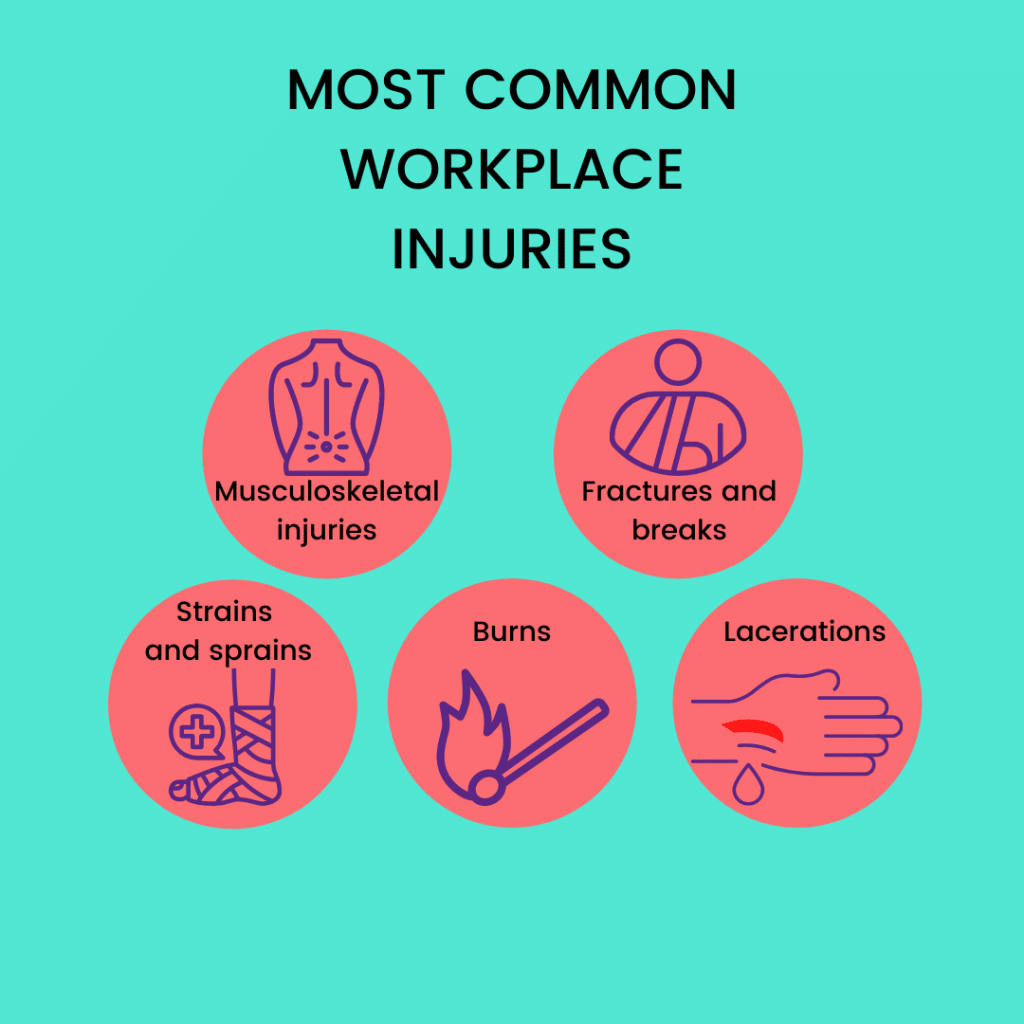
There are various ways you can be injured at work. The most common accidents are slips, trips, and falls, manual handling and carrying, being struck by a moving vehicle or falling object, and falls from height. Similarly, there are many injuries that you can have in these accidents. Some of the most common injuries at work include:

  • Musculoskeletal injuries
  • Fractures and breaks
  • Strains and sprains
  • Burns
  • Lacerations/open wounds

Musculoskeletal Injuries

The most common injuries at work are musculoskeletal disorders. According to the Health and Safety Executive (HSE), there were 480,000 Workers suffering from work-related musculoskeletal disorders (new or longstanding) in 2019/20.

Employers must protect workers from the risks of musculoskeletal disorders (MSDs) being caused or made worse by work. Musculoskeletal injuries include injuries and conditions that can affect the back, joints, and limbs.

The parts of the body most likely to be affected by musculoskeletal injuries are the lower back, shoulders, forearms, wrists and hands, neck, hips, legs, knees, ankles, and feet.

Workers can have different kinds of musculoskeletal conditions at the same time, and because of the same accident.

Claiming for Common Injuries at Work

It is your employer’s responsibility to keep you safe from a work accident. This means that they must make sure you have the correct training and equipment to be able to do your job correctly. They must also carry out risk assessments. This is to ensure it is safe to do the job.

If your employer has not followed the guidelines to keep you safe at work, or has done so incorrectly, you may be able to claim compensation. We understand that you may feel uneasy about claiming against your employer, however all employers must have employer’s liability insurance. This covers the costs of accidents at work. It is the insurance company who would pay the compensation, so your employer would not be directly out of pocket.

If you have had an accident at work, and your employer did not take precautions to keep you safe at work, then you may be able to make a compensation claim.

How we Can Help

Here at The Compensation Experts we work with people who have years of experience dealing with personal injury claims. This includes common injuries at work. So contact us today by filling in our contact form. Or call us on 01614138765 to speak to one of our friendly knowledgeable agents.

A Hornsea man says he was forced to walk on a “dangerous” part of the A1035 because the condition of the footpath was a “disgrace”. He said footpath accidents are waiting to happen due to the condition of the path, saying that some of it was underwater, and the rest was not any better.

“It’s a disgrace, had to take to walking on a dangerous part of the road. As footpath was underwater. The rest of the path isn’t any better, almost completely overgrown in parts.”

He said, across the East Riding, the council is responsible for 1,900km of paths and he he has raised the issue with the council in the past.

“I have reported it in the past, nothing came of it. That path is also part of the Hornsea Mere circular walk, meant to be one of the jewels in the crown for Hornsea.

“The road is the A1035, the main road into Hornsea from Beverley, so a busy stretch. So walking or cycling is rather risky due to the bends.

“Maybe if they [the council] were that concerned they should get one of their footpath officers to walk the path.”

A spokesman for East Riding Council said: “The council will investigate this section of footpath for defects and we have asked for the grass to be cut.

“Across the East Riding, the council is responsible for 1,900km of paths and obviously there will be many areas that need work. But our officers need to prioritise that work given the available budgets, which are under intense pressure.

“Our officers will continue their efforts to secure additional funding to upgrade the path from external sources.”

footpath accidents

Footpath Accidents

One of the most common types of public accident that we deal with are footpath accidents. Footpath accidents can happen due to potholes in the path or road, raised paving slabs, and more.

The Highways Act 1980 states that local authorities are responsible for keeping all roads and footpaths safe to use. This means a council has a legal duty to repair any damage that occurs to surfaces. They must do this by making repairs within six months of being notified of the risk. If a local council does not do this and someone has an accident, then they may be liable.

Proving Footpath Accidents

When you have a footpath accident, you may be wondering how you can prove that the accident was the fault of the council. The main thing you can do to prove your accident was due to a defect in the footpath is to take photos of the path. To make a personal injury claim, a defect on a footpath must be at least one inch deep or raised. This differs to defects on a road, which must be at least two inches deep and 12 inches wide.

How We Can Help

Here at The Compensation Experts we work with solicitors who have years of experience dealing with personal injury claims. This includes footpath accidents. Contact us today by filling in our contact form. Or call us on 01614138765 to speak to one of our friendly knowledgeable agents.

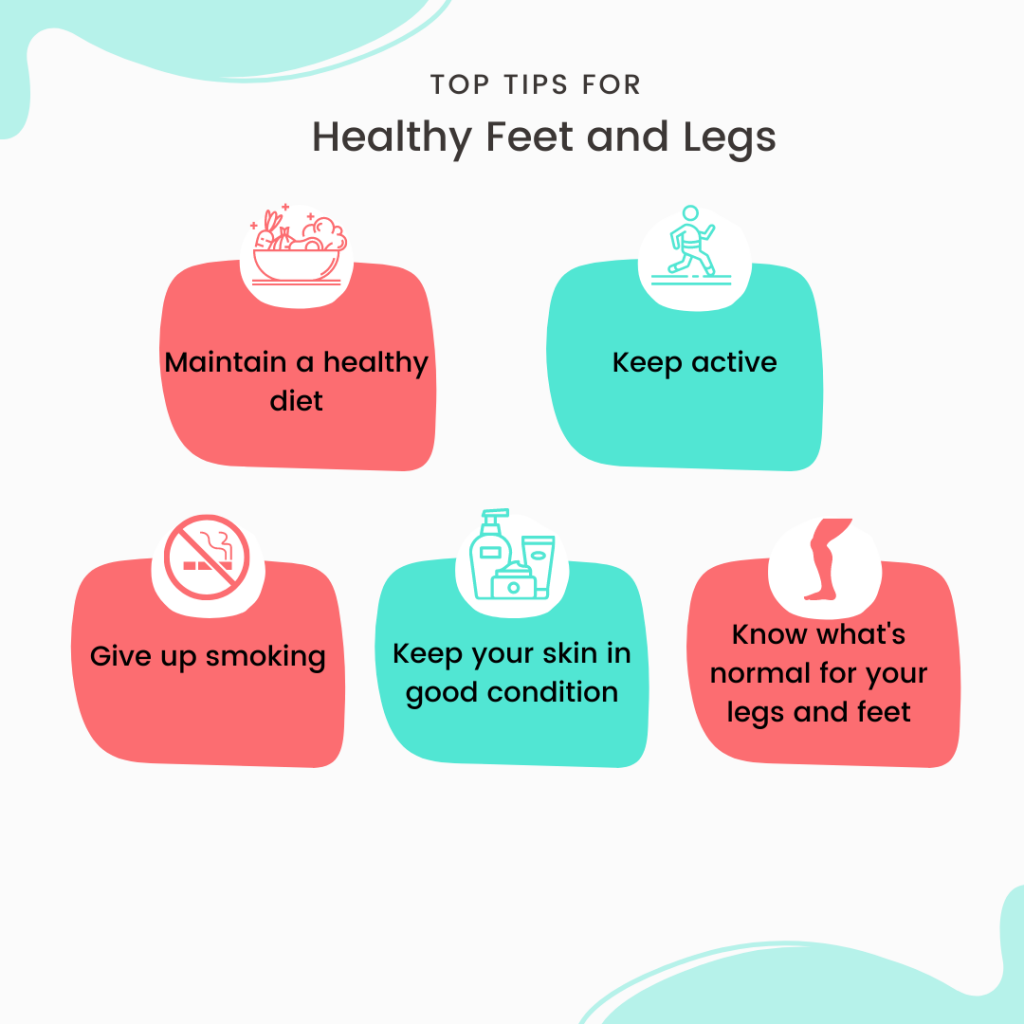
This week is legs matter week. Legs matter week is run by the organisation Legs Matter, and it aims to help people to take charge of their leg and foot health and start feeling their best again. This is especially important after a leg injury.

Leg Injury

When it comes to leg injuries, there are many different types, of varying severity. Any kind of leg injury can negatively impact your daily life, no matter how serious. You may find that you are in pain, unable to walk or struggling to perform your usual activities.

If the incident that caused the injury wasn’t your fault, you may be able to make a leg injury claim. Two of the most common leg injuries are strains and sprains, and fractures.

leg injury

Strains or Sprains

A strain occurs when the muscle or tendons (tissue that connects the bone to the muscle) become overstretched or tear. A sprain on the other hand is when the ligament (tissue that connects bones to other bones) is stretched or torn.

Sprains typically occur in the ankle, but are also common in the knee, whereas strains are more likely to occur in the hamstring. If you suffer a strain or sprain in your leg, you may not be able to walk or perform your normal activities properly for a few weeks.

More severe sprains and strains can take months to heal, and surgery may even be required. This can, therefore, affect your ability to earn, and have a negative impact on your day-to-day life.

Fractures

There are many different types of fractures, some of which can take up to 6 months to heal and may require surgery. This can affect your ability to walk, drive, travel and more.

Even arguably the least severe type of fracture, a stress fracture, can affect your ability to perform your usual duties. They occur when stress is repeatedly placed on the bone causing a small crack to appear. This can cause discomfort and pain to the sufferer.

At the other end of the spectrum is a compound fracture. If you suffer a compound fracture in your leg, you are likely to require surgery and it will take a considerable amount of time to heal. Compound fractures occur when a large force strikes the bone causing it to shatter into multiple pieces, and bones may also protrude through the skin.

Causes of Leg Injury

There are several causes of leg injury. Some of these include:

  • Accidents at work
  • Falling from height
  • Being struck by a falling object
  • Slips, trips, and falls
  • Road traffic accidents

If you have experienced an accident that causes a leg injury and it was due to someone else, then you may be able to make a claim for leg injury compensation.

How We Can Help

Here at The Compensation Experts, we work with solicitors who have years of experience dealing with personal injury claims. This includes claims relating to leg injury. Contact us today by filling in our contact form. Or call us on 01614138765 to speak to one of our friendly knowledgeable agents.

According to recent reports, a toddler has died following an accident on a farm. Public accidents on farms can be as common as workers accidents, and because of this, they can have devastating results.

The three-year-old was hit by a pick-up vehicle as he was playing with his sister and cousin at a farm at Rhosfach, Efailwen on August 3. Police and the Health and Safety Executive are still investigating what happened in the incident that saw the toddler lose his life, but his mother knows enough to say her son, who was playing on his bike, was killed almost instantaneously in the collision. She immediately rushed back to the farm but was not allowed into the farmyard to see her son while police carried out their investigations.

Public Accidents on Farms

As well as the staff at a farm, members of the public can also have farming injuries. The most common type of farming accidents that visitors experience include slips, trips, and falls, and collisions with vehicles. The owners of the farm have a responsibility to keep the public safe from accidents as well as their staff.

public accidents on farms

Occupier’s Liability Accidents

The types of accidents that generally come under occupier’s liability accidents include accidents in places where the public visits but are not owned by the council. Owners of properties must take steps to help ensure that people do not have accidents on their premises.

There are many causes of accidents that fall under occupier’s liability. Some of these include:

  • Slipping on wet surfaces
  • Tripping over uneven floors
  • Being struck by a falling object

These causes of accidents are easy to avoid. The owner of the premises should ensure that they put measures in place to avoid accidents like this from happening. They must ensure they follow rules set out in the Occupiers Liability Act 1957 to minimise the risk of accidents happening. If they fail to do this then they may be liable if someone has an accident on their premises.

Children’s Accidents

Some of the more common occupier’s liability accidents involve children. If children are visiting a place that falls under occupier’s liability, then the owner must take extra care to minimise the risk of children having accidents. This is because children tend to be less careful than adults whilst out in public.

If your child has had an accident is a public or private place, then you may be able to claim on their behalf. If your child is under 18, then a parent or guardian may make a claim for them. Their parent or guardian also has until the child turns 18 to make a claim. If the child is over 18 then they have until they are 21 to make a claim themselves.

How We Can Help with Public Accidents on Farms

Here at The Compensation Experts we work with solicitors who have years of experience dealing with personal injury claims. This includes public accidents on farms. Contact us today by filling in our contact form. Or call us on 01614138765 to speak to one of our friendly knowledgeable agents.

This week is back care awareness week. This year, the main focus of the week, which is run by the organisation Back Care, is focusing on back care at home. They do, however, state that they will also place some focus on back injury at work.

Types of Back Injury at Work

Back injury at work can occur from doing something you’ve done countless times before or completely out of the blue. Types of back injury include:

  • Fractures and breaks
  • Disc injuries
  • Back strains or sprains
  • Ligament and tendon damage
  • Nerve damage
  • Spinal cord damage
  • Lower back injuries

 Causes of Back Injury

There are also various causes of back injury. A number of these include back injury at work. However, there are also other causes. These include:

  • Repetitive Strain Injury (RSI). This can lead from inadequate training or poor health and safety procedures which have allowed you to continue a dangerous way of doing something, or from having equipment or furniture which positioned incorrectly to suit your needs, causing you to overcompensate physically.
  • Lifting something heavy, especially at work. Your employer has a legal duty to ensure that you know the correct procedure for lifting objects and that you have the proper equipment if required.
  • Tripping or falling in a public place. Anyone who has slipped on wet floor and landed awkwardly on their coccyx can tell you how painful an injury it can be.
  • A road traffic accident (RTA)which leaves you with spinal or muscular damage in your back.
  • Falling from a ladder, scaffolding, or platform which has not been secured correctly at work.
back injury at work

Preventing Back Injury at Work

Back injury at work can be common in many workplaces; after all, there are a lot of workplaces in which jobs require lifting. Ensuring you lift correctly can be key to not injuring your back at work. All staff members should be trained on how to lift correctly. This includes full-time, part-time, temporary and agency staff.

Employers should ensure that all their staff have had the correct and adequate training to lift and carry heavy loads. According to the Health and Safety Executive, employers must:

  • Avoid work activities that can cause back pain, where reasonably practicable
  • Where the activity can’t be avoided, assess it to see what they can do to reduce the risk of back pain
  • Apply the control measures they have identified and monitor and review them to make sure they are working
  • Consult their workers and, if they have health and safety concerns, do something about them

If your employer fails to do these things, then you may be able to make a claim for a back injury at work.

How We Can Help

Here at The Compensation Experts, we work with solicitors who have years of experience dealing with personal injury claims. This includes back injuries. Contact us today by filling in our contact form. Or call us on 01614138765 to speak to one of our friendly knowledgeable agents.

Starting today (4th October), Health and Safety Executive inspectors across Great Britain will be targeting construction firms to check that their health standards are up to scratch. The focus will be on respiratory risks and occupational lung diseases. This will hopefully crack down on industrial diseases caused by dust.

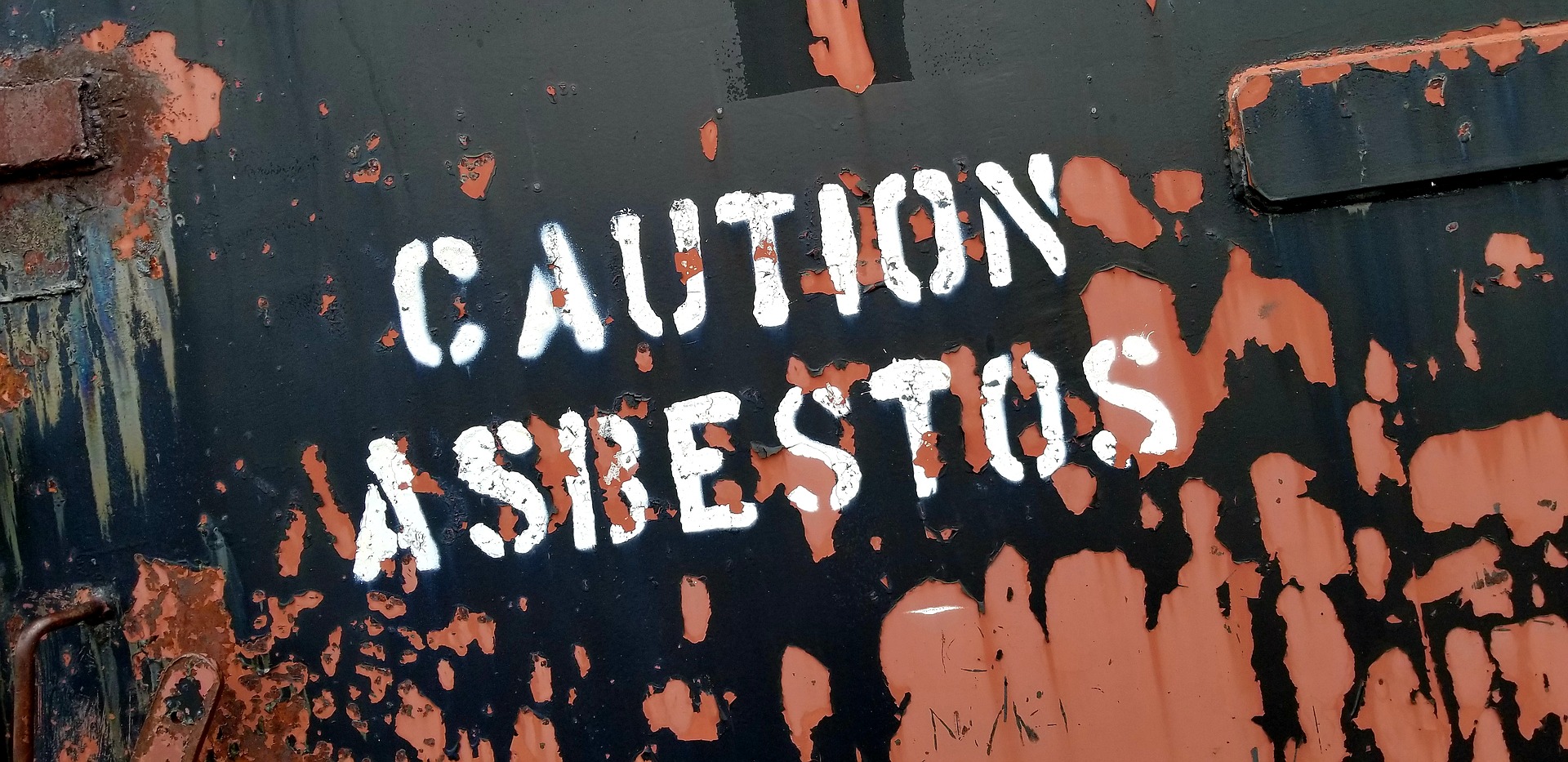
The inspection initiative will be a month-long effort. It will look at the control measures businesses have in place to protect their workers from construction dust including silica, asbestos and wood dust. This is part of HSE’s longer term health and work strategy to improve health within the construction industry. 

While the primary focus will be on health during this programme of inspections, if an inspector identifies any other areas of concern, including immediate safety risks, they will take the necessary action to deal with them.  

Inspectors will be looking for evidence of employers and workers knowing the risks, planning their work and using the right controls. If necessary, they will also use enforcement to make sure people are protected. 

More than 3,500 builders die each year from cancers related to their work, with thousands more cases of ill-health and working days lost. 

HSE’s chief inspector of construction, Sarah Jardine, said: “Around 100 times as many workers die from diseases caused or made worse by their work than are actually killed in construction accidents. 

“Our inspection initiatives ensure that inspectors are able to speak to duty holders and visit sites to look at the kind of action businesses in the construction industry are taking right now to protect their workers’ health, particularly when it comes to exposure to dust and damage to lungs. These are mature health challenges that the industry ought to be managing effectively.”

industrial diseases caused by dust

Industrial Diseases Caused by Dust

There are several industrial diseases caused by dust that we deal with here at The Compensation Experts. These include Asbestosis, Asbestos-Induced Lung Cancer, Mesothelioma, and Occupational Asthma.

Asbestosis and Asbestos-Induced Lung Cancer

Asbestosis is a disease where the lung tissue hardens. Prolonged and heavy exposure to asbestos dust can cause the disease. Asbestosis is a slowly progressive disease; it usually takes between 15 and 30 years to develop, after initial exposure to asbestos.

Exposure to asbestos also has a strong link with lung cancer.

Mesothelioma

Usually linked to exposure to asbestos fibres, mesothelioma is an aggressive form of cancer that develops in the lining that covers the outer surface of some of the body’s organs. There are more than 2,600 diagnoses each year in the UK; most cases occur in people aged 60 to 80, and it affects men more commonly than women.

Unfortunately, it’s rarely possible to cure mesothelioma, although treatment can help control the symptoms.

Occupational Asthma

Asthma is more than just a condition that develops in childhood. Asthma UK estimates up to 15% of the new diagnosis of asthma in adults is occupational asthma. Susceptible employees include wood dust workers (bakers and cabinet makers), animal and agriculture workers, hairdressers, and people who work with metals or solder flux.

How We Can Help with Industrial Diseases Caused by Dust

Here at The Compensation Experts, we work with solicitors who have years of experience dealing with industrial disease claims. This includes industrial diseases caused by dust. So contact us today by filling in our contact form. Or call us on 01614138765 to speak to one of our friendly knowledgeable agents.

Are you looking to invest your money into an investment fund? Here is everything you need to know about unit trusts vs investment trusts, and the difference between a unit trust and an OEIC.

OEIC vs unit trusts: what’s the difference?

When looking to invest your money in funds, you want to be sure that you’re placing it in a fund that is both secure and reliable. The last thing you want to happen is to be mis-sold investment funds.

If you’re looking to invest your money into funds, the two of the most common types of investment funds are known as unit trusts and open-ended investment companies (OEICs). Both these funds share a variety of traits, but they also have some important differences.

There is also a third type of commonly used trust known as an investment trust that you may want to consider if a unit trust or OEIC doesn’t appeal to you.

What are OEICs and unit trusts?

At first glance, there appears to be little difference between OEICs and unit trusts.

Rather than being an individual fund, both OEICs and unit trusts are what’s known as mutual funds. A mutual fund contains money from multiple different investors and is managed by someone known as a fund manager.

The fund manager takes the invested money and uses it to create a portfolio of investments and assets by investing in bonds or shares from a variety of businesses on the stock market. The total value of these investments is then divided into units, hence the name unit trust, each one being given to one of the fund’s investors. Investors can then exit the fund at any time by selling their unit.

What is an investment trust?

Unlike an OEIC or unit trust, an investment trust is a company that operates as a closed-ended investment fund. While OEICs are fluid in the size of their funds and investments, investment trusts hold a fixed number of shares and will typically retain the same value between the investors when an investor withdraws from the fund.

Investment trusts are seen as longer term investments that require time to fully reap the benefits, being more suited to static investments rather than things such as bonds.

When it comes to the difference between a unit trust and investment trust, if you want an investment you can reach and withdraw easily, a unit trust should be your pick.

OEIC vs unit trusts: similarities

Due to the effectiveness of both open-ended companies and unit trusts as potential investment opportunities, both types of funds have proved to be increasingly popular in recent years.

A large reason for this, and one of the core similarities between the two, is the fact that they can offer a practical and affordable way for clients to diversify their fund portfolio. With shares spread across numerous different asset classes, all managed by a separate individual, there is no pressure to make routine calls on individual stocks and shares to check and monitor their value.

This is particularly true if investors do not have the expertise required to manage stocks and shares professionally. Allowing another individual to handle the buying of units or shares can also provide a much wider spread of investment than an investor could have otherwise achieved with the same amount of money on their own.

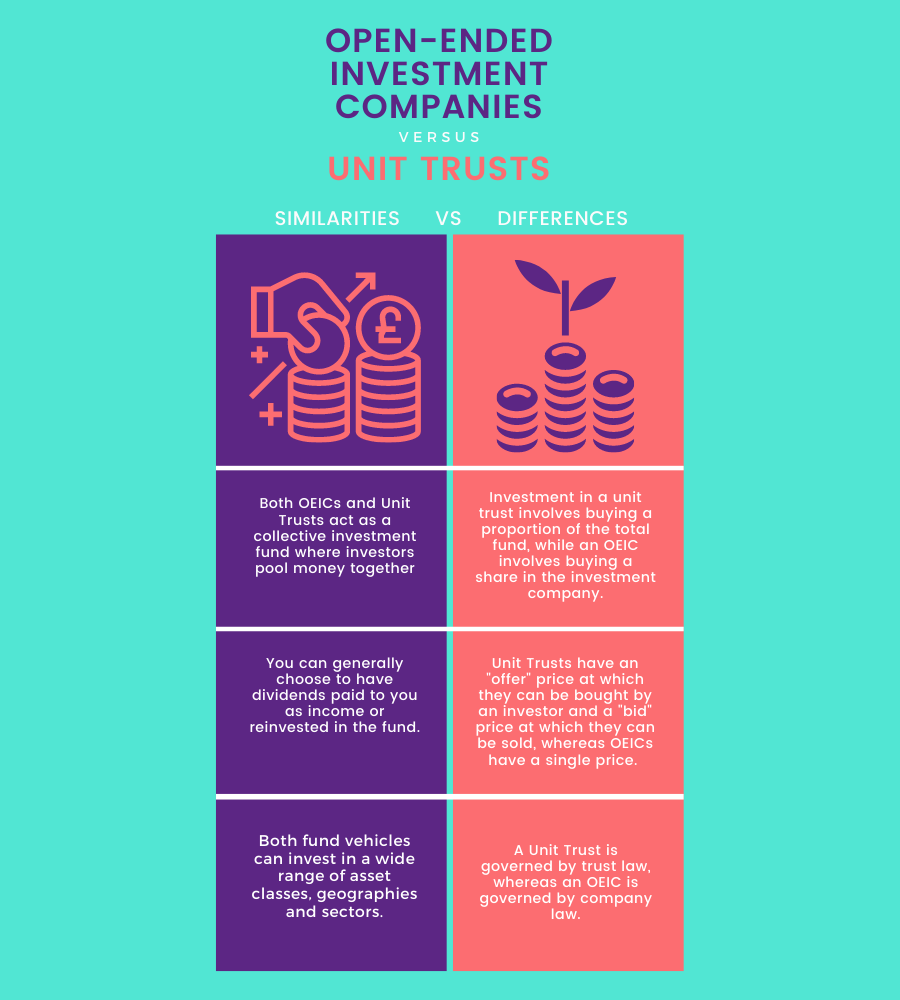
In many other respects, unit trusts and open-ended investment companies are the same types of funds. Despite the name difference, they’re both open-ended, and the price of each unit they provide is also dependent on the net asset value of the fund’s overall investment portfolio.

With open-ended investment companies and unit trusts, you can also generally choose to have dividends paid directly to you as income or have it reinvested in the fund if it’s performing well to increase future dividends.

On top of this, both fund vehicles can invest in a wide range of asset classes, geographies, and sectors. The collective nature of unit trusts and OEICs means that the invested money contributed by the number of investors can be pooled together for investment in the stock market. 

So, with so many similar aspects between them, you might be wondering why there’s a debate between investing in an OEIC vs unit trust to begin with.

Well, while both fund types might have a lot in common, both also have some pretty major differences.

The difference between unit trusts and OEICs

Without a doubt, when deciding between a unit trust vs OEIC, the main factor that will likely influence your choice will be the pricing of your chosen fund.

Unit trusts have what’s known as an offer price, a price at which an investor can buy into them. But on top of this, they also have what’s known as a bid price. This bid price is the price at which an investor can then sell their unit.

OEICs, on the other hand, have a single price for everything. This often makes OEICs more stable to invest in than unit trusts, as the price gap between a unit trust’s offer and bid cost is typically a 6-7% difference. Charges for an OEIC are simply deducted from the total amount invested.

Essentially, unit trusts come with added cost weight that should be taken into account when deciding between an OEIC vs unit trust.

Investment in a unit trust also involves buying a proportion of the total fund, the unit you are given when you invest in the fund, while an OEIC involves buying an actual share in the investment company. This makes it much clearer as to what you’re investing in when you opt for an OEIC vs unit trusts.

A final, subtle difference between the two is that trust law governs a unit trust, whereas company law governs an OEIC. This means there will be a variety of regulations you’ll need to consider when deciding on which fund to invest in.

Deciding on whether to invest in an investment trust or a unit trust vs OEIC

Now that you know the similarities and differences between an OEIC, unit trust, and investment trust, it’ll be up to you to decide which is more suitable for your needs.

OEICS have substantially increased in popularity in recent years due to their simplified structure, and many unit trusts have converted into OEICS as a result. That being said, unit trusts are still a popular choice. And if you want a long-term investment option, you might want to consider an investment trust.

Regardless of whatever type of fund or trust you’re interested in, it’s a good idea to do your research into investment funds and asset classes so you know what you’re investing into. And if you’re ever unsure about the legality surrounding any type of trust or fund, it’s always a wise idea to approach a qualified solicitor for advice.

Of course, when investing in any type of fund, there is always the risk that you may be mis-sold the investment. Whether it’s mis-sold investment bonds or a stocks and shares ISA, if you believe you’ve been misled on a financial fund investment, you might be able to make a mis-sold investment claim.

Here at The Compensation Experts, we work with solicitors who have years of experience with financial miss-selling claims. They’ll be able to help you tell the difference between OEIC vs unit trusts, as well as walk you through the claims process if you want to make one.

It goes without saying that there are a lot of bones in the human body that could potentially be broken: 206, to be exact.

Some of us are lucky enough to go through life without ever suffering an injury to any of the most commonly broken bones. But for many of us, chances are we’ll experience a break to a commonly broken bone at some point in our lives.

Had an accident that wasn’t your fault?

We’re here to help! We specialise in helping people who deserve compensation.

Start Your Claim

What is the easiest bone to break?

While any bone in our body can be broken, there are some bones that are easier to break than others. That being said, there is no single easiest bone to break. Instead, there is a group of the most commonly broken bones that you could suffer in the event of a personal injury.

When it comes to the most common broken bone, the following five are the ones that occur most often due to accidents:

  • Clavicle
  • Arm
  • Wrist
  • Hip
  • Ankle

That’s not to say that other bones may not be broken in the event of an injury, just that there is an increased likelihood that it could be one of these five.

Why are these the easiest bone to break in the body?

The primary cause for the breaking of bones is extreme or sudden pressure on the affected area, typically involving the twisting of the bone in some way. As the five bones we’ve previously mentioned are all located in areas that experience pressure regularly, it’s unsurprising they’re more likely to break than other bones.

Collarbone / clavicle

The clavicle, more commonly known as the collarbone, is statistically the most common broken bone in the body. It’s also the most common fracture suffered by children.

Any accidents, from a road traffic accident to accidents in the workplace, can result in the break of this most common broken bone, but an injury to the clavicle can happen beginning from birth; with fractures making up several birth injuries.

What makes the clavicle the most common broken bone in the body when it comes to accidents is the fact that most people will put their arms out in front of them when falling. This applies maximum pressure to the clavicle, which can cause it to break.

Arm fractures are also another common fracture and break type, particularly the Humerus and Ulna bone. They are the second most commonly broken bone in children and make up almost half of the fractures in adults. A break to the arm occurs in much the same way as a break to the clavicle, as do breaks to the wrist.

As for wrists, they are the most commonly broken bone in people under the age of 75, since they’re most often caused by physical activity like sports injuries. If older people do sustain a wrist fracture, it’s usually because they suffer from osteoporosis, a condition that causes bones to become thin and brittle.

When it comes to leg injuries, broken hips are the most commonly broken bone in people over 65; accounting for 90% of all hip fractures. Hip fractures often require surgery to “pin” the edges of the fracture back together, but a severe fracture sometimes requires a total hip replacement. Landing hard on your hip from a fall is typically the most common reason for hip breaks.

Lastly, ankles are also prone to breakage with surprising regularity. However, with an ankle injury, it can sometimes be difficult to know if a break has occurred, as even a sprained ankle can be very painful and prevent the sufferer from walking.

As well as the more obvious breaks, ankles can sustain stress fractures, which are when the bone cracks as a result of repeated pressure on it but doesn’t break entirely.

What are the most painful bones to break?

While the previous breaks we’ve mentioned might sit as the easiest bones to break, not all of them fall under the range of most painful bones to break. Some bones are so important that when we break them our body tells us immediately, but for others, it’s simply difficult not to apply pressure to them whilst they’re healing.

When it comes to the most painful bones to break, the following three are considered particular painful injuries to suffer in an accident:

  • Femur
  • Tailbone
  • Ribs

The Femur is often put at the top of the most painful bones to break. Your Femur is the longest and strongest bone in your body, running from your hip to your knee. Given its importance, it’s not surprising that breaking this bone is an incredibly painful experience, especially with the constant weight being put on it.

The tailbone, on the other hand, while difficult to break, can also be particularly painful if damaged; more for the fact that pressure is often applied to it while sitting for recovery.

Rib injuries also fall into much the same category. Even bruises to your ribs can be exceedingly painful, but a break can often be excruciating due to the constant chest pressure from breathing, and potential internal injuries caused by the rib when it breaks.

How to tell if you’ve broken a bone

While a common term for a broken bone is a break, the more commonly used medical term is a fracture. There are three main types of fracture, each constituting a different kind of break:

  • Hairline fractures
  • Simple fractures
  • Compound fractures

Each type of fracture has a different recovery period; hairline fractures tend to heal relatively quickly and easily due to it not being a full break in the bone. Simple fractures also tend to heal quickly but can sometimes require further treatment if the break is more complex.

Compound fractures are the most serious type of break and can take a long time to heal. If they’re exceedingly complex, they may even require physiotherapy, surgery. or skin grafts to repair the bone’s surrounding tissue.

It’s usually fairly obvious when you’ve broken a bone, but not all breaks are as clear as others. I’ve you’ve simply fractured a bone; you may not even realise it until much later.

The three most common signs of a broken bone are pain, swelling, and deformity around the area in question. Not all of these signs are required for a bone to be classified as broken, but a least one is often an indication of serious injury.

If you’re unsure if you’ve broken a bone, you should seek out the correct treatment regardless as soon as possible to avoid serious infection or a permanent deformity.

In many cases, breaking a bone is an unavoidable consequence of everyday life. But if you’ve suffered an arm injury or leg injury due to someone else’s negligence, you might be able to make a personal injury claim. Get in touch with our expert team today to find out how much you could potentially claim for.

Get in touch with our expert team today to find out how much you could potentially claim for.

Start Your Claim

A 75-year-old woman recently fell down on a footpath and suffered two black eyes and bruising. The pensioner fell down a pothole in the town of Skelmersdale. Pothole falls such as this are common and are a main cause of public liability claims.

Her daughter has branded footpaths ‘treacherous’ all over the town and is calling on the council to sort out the problem to stop anyone else from suffering in this way.

She says “The pavements are so treacherous in Skelmersdale. Something has got to be done because it’s a widespread problem. The underpasses get flooded and people have to walk in those places. Those footpaths are dangerous, and the subways get flooded when it’s raining so you can’t go through them, and people have to walk through them all the time.

“The majority of the footpaths and subways in Skelmersdale are not fit for purpose. The majority of the footpaths are a disgrace. Nothing seems to get repaired in Skelmersdale and people are fuming because of the state of the place.

Pothole Falls

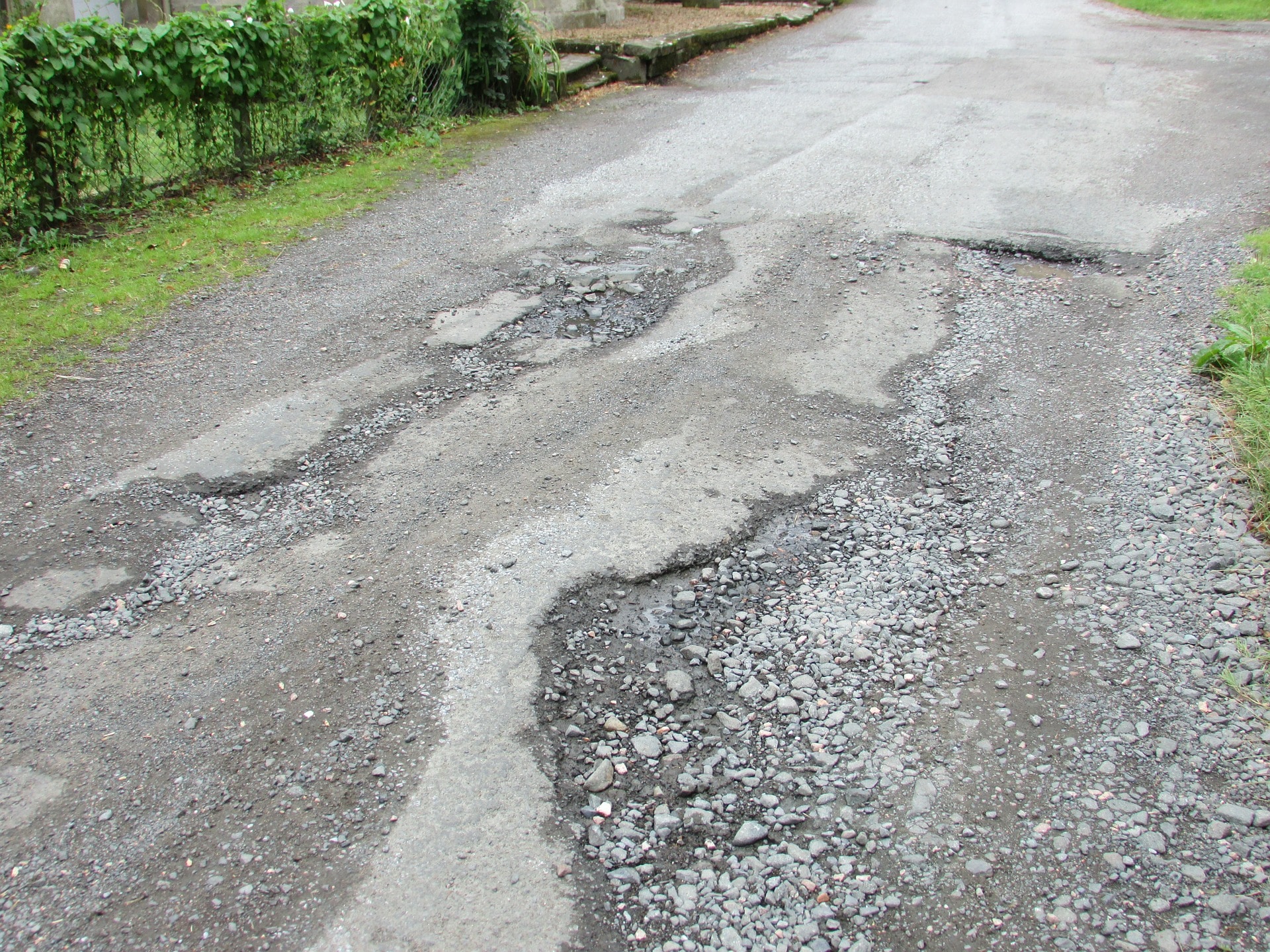
Pothole falls are amongst the most common type of public liability accidents. Most of these types of accidents are slips, trips, and falls. These accidents can happen on the pavement, on the road or on public footpaths in parks.

There are certain rules when claiming for tripping on a pothole or defect in a pavement or road. On a pavement, a pothole or defect must be at least an inch deep or raised. In the road, this must be at least 2 inches deep and at least 12 inches wide.

pothole falls

Compensation Claims against the Council

The Highways Act 1980 states that local authorities are responsible for keeping all roads and footpaths safe to use. Keeping all roads and pavements marble smooth at all times is both unnecessary and impractical. However a council has a legal duty to repair any damage that occurs to surfaces. They must do this by making repairs within six months of being notified of the risk. If a local council does not do this and someone has an accident, then they may be liable.

Did you suffer injury on council property due to their failure to fulfil their duty of care? If so, The Compensation Experts can guide you through the process of making a claim against the council.

Council compensation claims can include:

  • Damage sustained from pothole falls from a pothole that is more than one inch (2.5 centimetres) deep.
  • Tripping on a pothole while walking
  • Cycling into a pothole and being hurt in a resulting crash
  • A pothole causing a car accident in which you are injured, or your car damaged
  • Tripping on uneven paving or pavement where a stone is sticking up by at least one inch

How We Can Help

Here at The Compensation Experts, we work with solicitors who have years of experience dealing with personal injury claims. This includes pothole falls. Contact us today by filling in our contact form. Or call us on 01614138765 to speak to one of our friendly knowledgeable advisors.

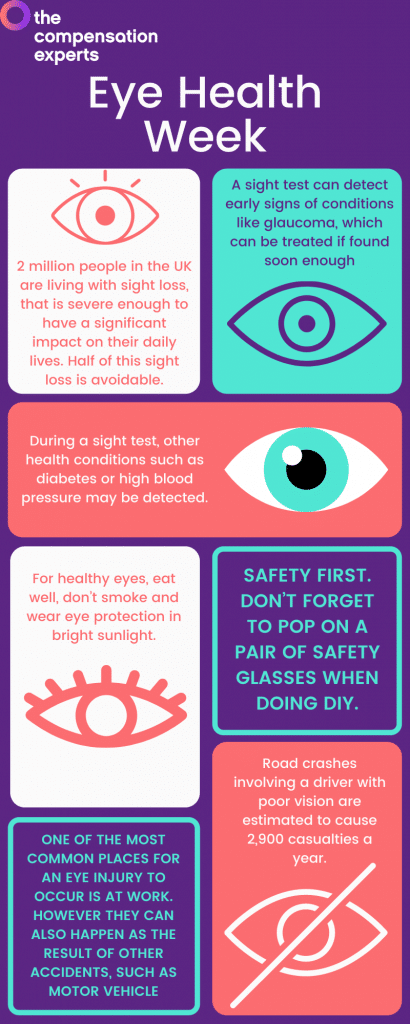
This week (20th-26th September) is eye health week. Eye Health week is run by Vision Matters and aims to promote the importance of good eye health and the need for regular eye tests for all. There are many reasons why eye health week is important and preventing injuries to the eye is one of these.

Injuries to the Eye

There are many causes of injuries to the eye. These include:

  • Abrasions or scratches to the eye’s surface
  • Fracture of the orbital socket (the area of bone around the eye)
  • Penetrating eye injury, as a result of punctures by a foreign body, such as a metal splinter or glass shard
  • Chemical injury, heat, or radiation burns
  • Negligent corrective laser eye surgery

One of the most common places for a person to suffer an injury to the eye is at work. However, they can also happen as the result of other accidents, such as road traffic accidents, or accidents in public or private places.

injuries to the eye

Preventing Injuries to the Eye at Work

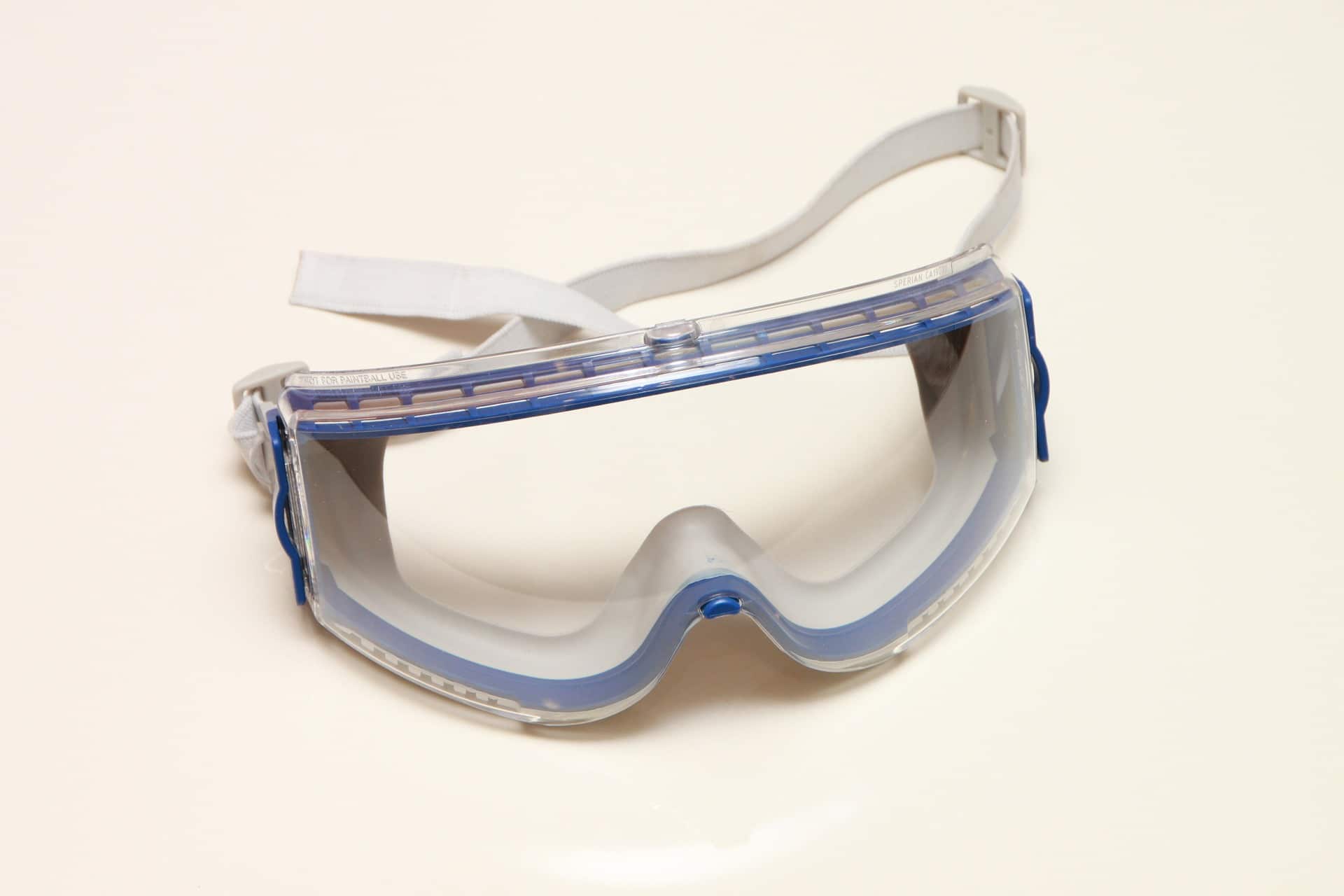
Some of the main things you can do to prevent an injury to the eye at work include knowing the eye safety dangers at work, completing an eye hazard assessment, eliminating hazards before starting work, and using machine guarding, work screens, or other engineering controls. Proper eye protection is also vital, so making sure your employer provides this is important.

If your employer fails to provide you with the correct eye protection, then they may be at fault for your injury. If this is the case, you may be able to claim compensation.

The Effects of Injuries to the Eye that Cause Sight Loss

Losing your sight can change your life. And if the injuries were caused by an accident that was not your fault, then you may be entitled to compensation. Losing your sight, even only temporarily, can cause drastic life changes. These changes can include changes to your daily life, changes to your employment, and changes to your routine. You may have to get assistive equipment to do daily tasks, or even learn Braille. This can be quite a drastic change, and may affect you mentally as well as physically.

We understand that this may be a traumatic experience, and it may affect your independence. This is all taken into consideration when you make a claim. You can either claim compensation for loss of sight in one eye or for full blindness, and either may cover any required changes to your home.

A lot of people who experience more permanent effects from an accident may also need a carer. Many choose a relative or close friend, as that is who they feel most comfortable around. If you were to make a sight loss claim, then the financial implications for your carer may also be accounted for in the compensation you receive.

How We Can Help

Here at The Compensation Experts we work with solicitors who have years of experience dealing with personal injury claims. This includes injuries to the eye. Contact us by filling in our contact form. Or call us on 01614138765 to speak to one of our friendly knowledgeable advisors.

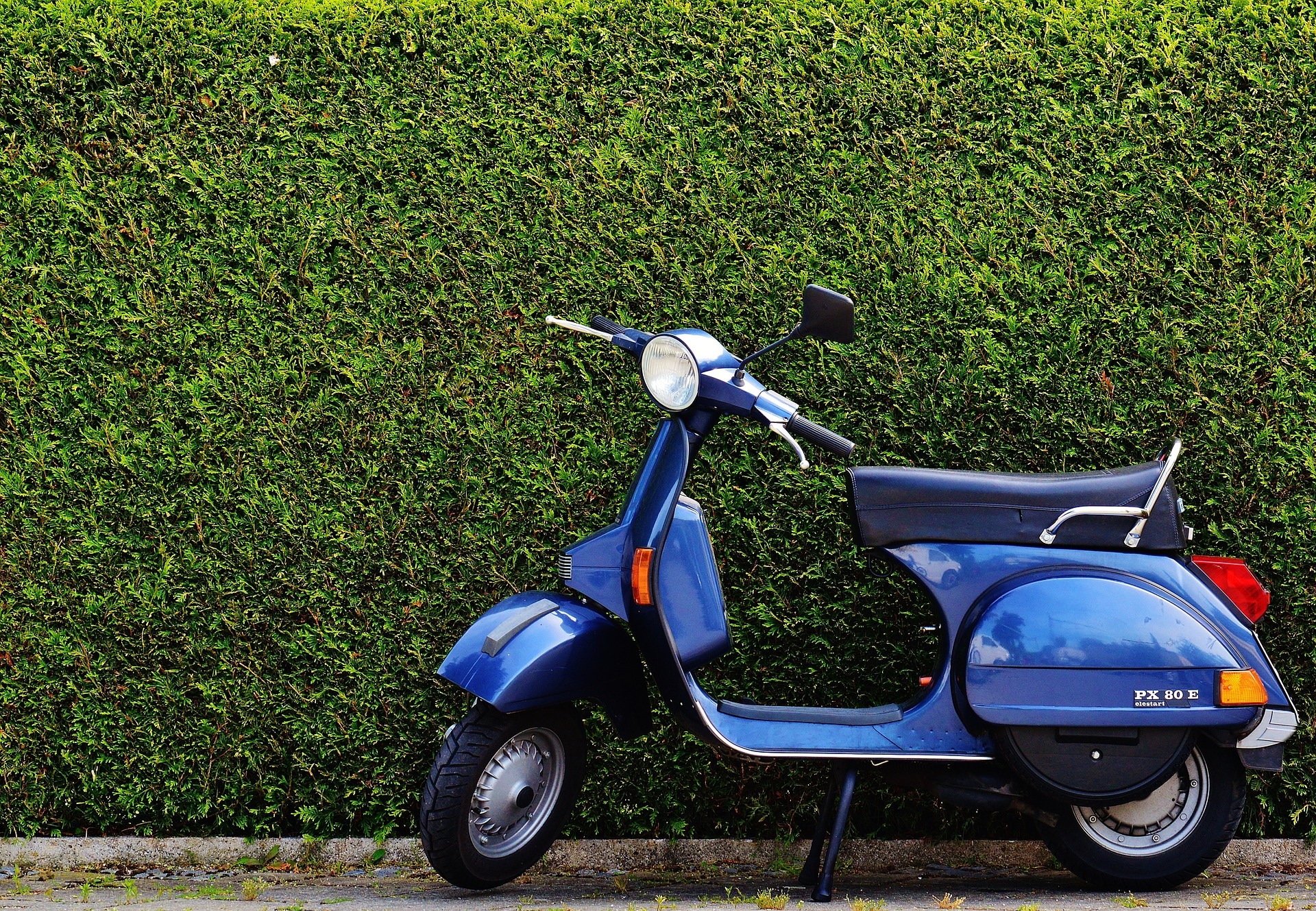
Police are appealing for witnesses after a man in his 60s was seriously injured when he was hit in a hit and run accident by a stolen moped in Leeds.

The man was crossing the road on South Parkway at a junction on Wednesday 8 September when the moped overtook a bus at about 50mph and hit him. Police said he went to hospital with serious head injuries and a number of broken bones.

The passenger on the moped was subsequently arrested. Police have now issued a CCTV image in a bid to identify the rider “who was wearing a distinctive helmet”.

Motor Insurers Bureau Claims after A Hit and Run Accident

If the cause of the road accident was an uninsured or untraced driver, you may still be able to make a claim. This claim is from the Motor Insurers Bureau

The Motor Insurers Bureau is an organisation that insurance companies pay into in an accident with these drivers. This would be the case if the accident was a hit and run accident. The Motor Insurers Bureau will then pay the compensation rather than the insurance company.

If a vehicle hits you and you did not get the details of the driver, you may also be able to make a claim for compensation from the Motor Insurers Bureau.

You can also make Motor Insurers’ Bureau claims if you have an accident involving a driver who is uninsured.

hit and run

MIB Minor Injuries Claims

The Motor Insurers’ Bureau also includes claims following the whiplash reforms. They launched the Official Injury Claim portal. This is a free and official service for people who suffer road traffic accident related minor injuries, such as whiplash, to claim compensation without the need for legal representation.

Developed on behalf of the Ministry of Justice, this easy-to-use online service guides someone through the process of making a claim, obtaining a medical report, managing that claim and, if their claim is successful, receiving compensation.

They state that someone who has an accident can use Official Injury Claim for claims up to £5,000 for a personal injury. They rise to a total of £10,000 for all losses related to the accident. This includes loss of earnings and damage to your car and property.

The MIB built the new service to make the claims process inclusive and accessible to as many people as possible.

How We Can Help

Here at The Compensation Experts, we work with solicitors who have years of experience dealing with personal injury claims. This includes a hit and run accident claim. Contact us today by filling in our contact form. Or call us on 01614138765 to speak to one of our friendly knowledgeable advisors.