Start your claim now

Swimming can be extremely beneficial to children and learning to swim and being confident around pools can help this. However, with children being around water whilst they are learning to swim, children’s accidents in swimming pools are more common.

There are some instances where children’s accidents in swimming pools are unavoidable. However, where a child has an accident in a swimming pool, and this accident is caused by the negligence of someone else, then you may be able to make a claim.

children's accidents in swimming pools

The Most Common Children’s Accidents in Swimming Pools

There are many accidents that a child can have whilst at the swimming pool. Some of the most common accidents include

  • Slipping on wet surfaces
  • Tripping over uneven floors or obstacles left around the poolside
  • Being struck by a falling object
  • Illness as a result of the use, non-use or misuse of certain chemical disinfectants
  • Diving board injuries
  • Broken tiles on the sides or floor of the swimming pools
  • Injuries caused by another child
  • Drowning

Constant supervision of children whilst they are in the pool is essential. According to the Royal Society for the Prevention of Accidents (RoSPA) children under the age of 11 years are most at risk of accidents and drowning in swimming pools, and toddlers are the most vulnerable.

Accidents can occur through inadequate procedures, insufficient training, and being short on staff. Negligence caused by staff can quickly turn what should be a safe and pleasant environment into a perilous one. The swimming pool owner, centre manager, and lifeguards all have a duty of care to ensure swimming pool accidents are avoided, and customers and staff are kept safe. Legislation like the Occupiers’ Liability Act 1957 clearly sets out their responsibilities.

Claiming on Behalf of a Child

If a child is injured in a swimming pool accident, then you may be able to make a claim on their behalf. In cases where a child has an accident, a parent or guardian may be able to make the claim on their behalf.

Usually in personal injury claims, there is a three-year time limit on making the claim. However, if a child has an accident, this is not the case. When a child is injured, a parent or guardian has until the child turns 18 to make a claim. The child then has a further three years to claim, until they turn 21.

We do recommend, however, that you start the claim on behalf of the child as soon as possible after the accident.

How We Can Help with Children’s Accidents in Swimming Pools

Here at The Compensation Experts we work with solicitors who have years of experience dealing with personal injury claims. This includes children’s accidents in swimming pools. So contact us today by filling in our contact form. Or call us on 01614138765 to speak to one of our friendly knowledgeable advisors.

August was designated National Road Victims Month following the death of Princess Diana on 31st August 1997, and to commemorate the first death by a motor vehicle – Bridget Driscoll in 1896. Since then, well over half a million people have been killed on the roads in Britain.

And over the last decade, the number of people killed on Britain’s roads has stayed at the same level year on year. Five people are killed every day, and over 60 are seriously injured. This is why road traffic accident claims are important during National Road Victims Month.

National Road Victims Month

Road Traffic Accidents and National Road Victims Month

If you have been injured in a road traffic accident, then you may be able to claim compensation. This is especially true if someone else was at fault for your accident. National Road Victims Month recognises people who have had road traffic accidents as a passenger, driver, pedestrian, motorcyclist, cyclist, and more.

You could claim road traffic accident compensation for an injury, if you were not at fault. The most common reasons for road traffic accident claims are:

  • Another driver’s error or lack of concentration
  • Poor conditions due to inadequate lighting or large potholes
  • Unclear signs
  • Other distractions such as smoke from a bonfire in a neighbouring field blowing across the road

Road traffic accident or Motor Insurers Bureau claim?

If you are the victim of a road traffic accident and you did not get the details of the driver, you may still be able to make a claim for compensation from the Motor Insurers Bureau.

The Motor Insurers Bureau is an organisation that insurance companies pay into, in the event of an accident where one of the parties is an uninsured or untraced driver. This would be the case if the driver involved in your pedestrian accident either drove away or they were uninsured.

However, you must report all road traffic accident to the police at the time of the accident, or soon afterwards. The Motor Insurers Bureau will then pay the compensation rather than the insurance company.

National Road Victims Month: Claiming on behalf of a child

If your child has had an accident on the road, you can make a claim on their behalf. Children are the most vulnerable road users, so it is likely that the driver may be responsible for any road accident.

A child has longer to claim for a road accident than an adult; usually, you have three years, but a child would have until they turned 21 to make a claim. A parent or guardian can make the claim until the child turns 18. They then have until they turn 21 to make a claim themselves.

How We Can Help

Here at The Compensation Experts we work with solicitors who have years of experience dealing with personal injury claims. This includes road traffic accidents. Contact us today by filling in our contact form. Or call us on 01614138765 to speak to one of our friendly knowledgeable advisors.

Lots of people switched to home working over the last few years – but post-pandemic, as we head back to the office, it’s easy to overlook important workplace health and safety tips.

Because we haven’t been in the workplace for so long, it’s important to be extra cautious when we return to reduce potential accidents at work. It doesn’t matter if you work in an office or on a construction site; safety should always come first.

So, to help you get fully prepared for your return to the workplace and improve the safety of your place of work overall, we’re outlining five workplace safety tips that you can implement to keep employees safe while working.

1. Create and implement a safety programme

The first of our workplace safety tips is an important one, and that’s ensuring you have some kind of safety programme in place that relates to the hazards experienced in your specific industry.

Before your employees return to your place of work, take the time to have a walk through it. Check every room in the office and all areas of your factory with an eye on identifying any potential hazards.

These could be major things, like worn-out holdings, loose cables, or even damage to the building itself, or they could be minor, such as an over-stacked shelf. Either way, with this information in hand, you can take steps to remove these hazards.

But that’s only half of this safety tip. When staff come back, you should set aside half a day where you can train them on how to keep the office safe and encourage them to report potential hazards when they see them to a manager or in a logbook.

It would also be beneficial to send some of your employees on first aid and mental health counselling courses, just in case anything should happen onsite. As health and safety tips go, this last piece of advice can often be the difference between major and minor personal injuries in workplace accidents.

2. Keep your place of work clean and tidy

Keeping your workplace tidy and organised is perhaps the most important of all workplace safety tips. You may not think by looking at it, but tripping on a stray bag can lead to a serious trip, slip, or fall injury.

Explain to your employees why personal belongings should be kept safely under desks or in lockers where possible. You should also talk them through why a clean working environment is important to avoid falling objects or stay trip hazards.

But where this safety tip is even more important is on construction sites and in factories. One rogue toolbox is all you need to cause injury to someone, and if up high, a potentially fatal accident.

Where possible, educate your workforce with safety tips on how to avoid leaving potential hazards in busy locations. For example, any spills should be cleaned up the moment they’re spotted, and broken objects should be moved to a safe location.

You should also be looking to ensure that the building you work in is up to industry standards. Loose wires and cables are a sure-fire way for your employees to injure themselves if they trip over them, and loose roof tiles can dislodge in strong winds.

3. Empower your employees with the information they need

Just because certain menial tasks may not be stated on an employee’s contract, it doesn’t mean they won’t have to carry said tasks out at some point in the workplace.

For example, as a general rule, office workers may not be required to do a lot of heavy lifting. However, there may be an occasion where a heavy parcel gets delivered, or employees are moving desks and need to lift computer monitors and chairs.

So, if you know that something like this is likely to happen in your place of work, providing employees with the knowledge they need to do it safely and injury-free is a must when it comes to safety tips.

There are a wealth of tips you can find online about how to correctly lift or move objects, as well as educational courses you can send your employees on.

4. Set up all equipment correctly and regularly audit it

Incorrectly set up or damaged equipment are workplace accidents just waiting to happen. Unfortunately, this kind of hazard can often be hard to spot unless you’re actively looking for it.

Before your employees return to their place of work, you should take the time to ensure all equipment is set up or maintained correctly. This might mean tightening desk bolts or replacing damaged furniture.

If you work in construction or with chemicals, this means ensuring each and every tool and piece of safety equipment is in perfect working order. If it’s not, it needs to be repaired or replaced immediately.

Upon your employees’ return, you should also take time to re-educate them on how to correctly use the tools at their disposal. In an office, for example, have everyone learn to properly adjust their chairs and monitors for correct ergonomic support.

And above all else, the last key part of this workplace safety tip is to audit everything regularly. The sooner you spot a problem, the sooner any potential workplace accident can be avoided.

5. Always avoid the temptation of shortcuts

It might sound obvious, but mistakes are most likely to happen when tasks are done quickly and without proper preparation. When implementing safety measures, don’t cut corners.

With your employees, you must stress that their safety is the most important thing to you. You should encourage your employees to complete a task they’ve done before with adequate safety measures in place to help encourage this new mindset of safety first.

This also goes for any tool repairs, equipment set up, and building repairs. In short, never, ever take shortcuts when it comes to workplace safety.

With those five workplace safety tips in hand, you should now have a much better understanding of how to avoid accidents and injuries in the workplace. Implement them today and you can welcome your employees back knowing they’re safe. Injuries in the office may not be as common as other workplaces like construction sites or factories, but that doesn’t mean they don’t occur. However, by taking the steps to safety-proof your office, and educating your employees on the role they play too; you’re helping to significantly reduce the risk.

Of course, as much as we try to follow safety tips, accidents are sometimes unavoidable. However, if you’ve suffered an accident at work that wasn’t your fault, then you should get in touch with The Compensation Experts today to start your claim.

We’ll put you in touch with expert solicitors in the field of personal injury. They’ll work with you to build your case, estimate how much you could claim, and walk you through the claims process; keeping you informed every step of the way.

For more safety information, head on over to our blog, or to find out more about claiming for an injury, get in touch with us.

According to recent reports, a 70-year-old man has been involved in a fatal motorcycle accident. He was killed in a crash with a car.

Police were called to the crash between a motorcycle and a silver Vauxhall Astra in Wilmslow, Cheshire. The motorcyclist, from Wilmslow, died at the scene and the police informed his next of kin following the accident.

Fatal motorcycle accidents may not be any more common than car crashes. However, the lack of vehicle protection leaves riders incredibly vulnerable to catastrophic injury. Even the most responsible rider who follows the Highway Code and wears the correct protective clothing may have an accident.

fatal motorcycle accident

Motorcycle Accidents

Nearly three-quarters of all motorcycle accidents involve a car, van, or lorry.

The biggest reason behind motorbike accident claims, accounting for nearly two-third of all cases, is the driver of the other vehicle ignoring the motorcyclist’s right of way. This either occurs because they have not seen the motorcycle until it is too late, or because they are unaware of the laws about motorcyclists rights on the roads.

The number one cause of motorbike accident injuries, however, is another vehicle making a left turn in front of the motorcyclist at a junction. Other common examples of motorcycle accident claims include:

  • Drivers may misjudge the speed of an oncoming motorcyclist. A collision can lead to serious motorbike injuries, with the rider much less protected than the driver.
  • A motorcyclist may not be in a driver’s direct vision. If a rider is in a car’s blind spot, a driver may unintentionally swerve and cause a motorcycle accident.
  • Drivers may not make sure to check for oncoming motorcyclists before opening their car door.
  • A driver or motorcyclist may underestimate or potentially not be aware of adverse road conditions.

Some of the most common examples of motorcycle injuries are:

  • Fractures
  • Whiplash
  • Head and spinal injuries
  • Fatalities

Causes of Fatal Motorcycle Accidents

There are many causes of fatal motorcycle accidents. However, at the Compensation Experts we have found that the most common cause of fatal road accidents is from another person’s careless driving. This includes errors, lack of concentration, driving whilst under the influence of drugs or alcohol, speeding, using mobile phones or other technology whilst driving, and not taking care of lights and signs whilst driving.

Poor conditions on the road may also cause a fatal motorcycle accident. These include inadequate lighting, large potholes, unclear signs, and other distractions such as smoke from a bonfire in a neighbouring field blowing across the road.

If a loved one has suffered a fatal motorcycle accident, then you may be able to claim on their behalf.

How We Can Help

Here at The Compensation Experts we work with solicitors who have years of experience dealing with personal injury claims. This includes fatal motorcycle accidents. Contact us today by filling in our contact form. Or call us on 01614138765 to speak to one of our friendly knowledgeable advisors.

The Health and Safety Executive (HSE) has recently published a report which shows that agriculture has the worst rate of fatal injuries of all the major industrial sectors. The report shows that, from 1 April 2020 to 31 March 2021, there were 41 fatal injuries on farms and agricultural related activities. This is almost double the previous year, and around 20 times higher than the average five-year annual rate across all industries.

The acting head of agriculture at HSE said: “Agriculture is a vital part of our economy and everyone involved is rightly proud of the quality and standard of the food produced.

“It is not acceptable that agriculture continues to fail to manage risk in the workplace. We need everyone to play their part to improve their behaviour, do things the right way and ‘call out’ poor practices whenever they are seen.

“There are simple safety measures people should follow to reduce injury like remembering to put on handbrakes, fasten lap belts in cabs, make sure anyone operating a quad bike wears a helmet and receives sufficient training, don’t put cows and calves in fields with public footpaths; and make sure to switch off the power to vehicles or machinery before attempting to carry out repairs.”

Common Causes of Fatal Injuries on Farms

The most common causes of fatal injuries on farms were

  • struck by moving vehicles
  • killed by an animal
  • struck by an object
  • falling from height, and
  • contact with moving machinery.

There are also risks of farm injury to workers when it comes to enclosed spaces. These include slurry pits, silos, and fuel storage tanks. Working in these spaces can cause drowning, asphyxiation, or exposure to toxic gases. Other industrial illness claims that farm workers may develop include noise-related hearing loss, respiratory diseases, certain types of cancer, and even vibration white finger.

Employer’s Responsibility

Your employer is responsible for keeping you safe at work. On a farm, this is even more important, as there are a lot of things that can cause an injury. Your employer must make sure that they meet the Management of Health and Safety at Work Regulations (1999). They do this by conducting risk assessments to ensure that they keep everyone safe. Agricultural employers must make sure that they do everything possible to avoid staff having farm related injuries whilst at work.

If you have a farming accident and have to take time off work, you should get agricultural sick pay. This means that you should get at least the agricultural minimum wage whilst you are off. This is, however, likely to be less than your usual wage.

If you are self-employed, you may still be able to make a claim. Farm workers are often self- employed on a contractor basis. This means, importantly, there is still usually a company that they are working for. If the business you are working for fails in their duty to keep you safe, then they may be responsible for your farm accident.

How We Can Help with Fatal Injuries on Farms

Here at The Compensation Experts we work with solicitors who have years of experience dealing with personal injury claims. This includes fatal accidents on farms. So contact us today by filling in our contact form. Or call us on 01614138765 to speak to one of our friendly knowledgeable advisors.

The UK has a long-standing love affair with cycling. In fact, there are over 7.5 million Brits who partake in the sport. And with city congestion making road travel as slow as ever, it’s becoming increasingly tempting to navigate the urban jungle on two wheels rather than four. But which UK towns and cities are the most cycle friendly?

We’ve conducted research, to determine the areas that see the fewest cycling accidents, endure the least bike thefts, enjoy the most manageable traffic, and demonstrate the most enthusiasm for the sport. With this data, we’ve managed to rank and reveal the UK’s city-cycling hotspots.

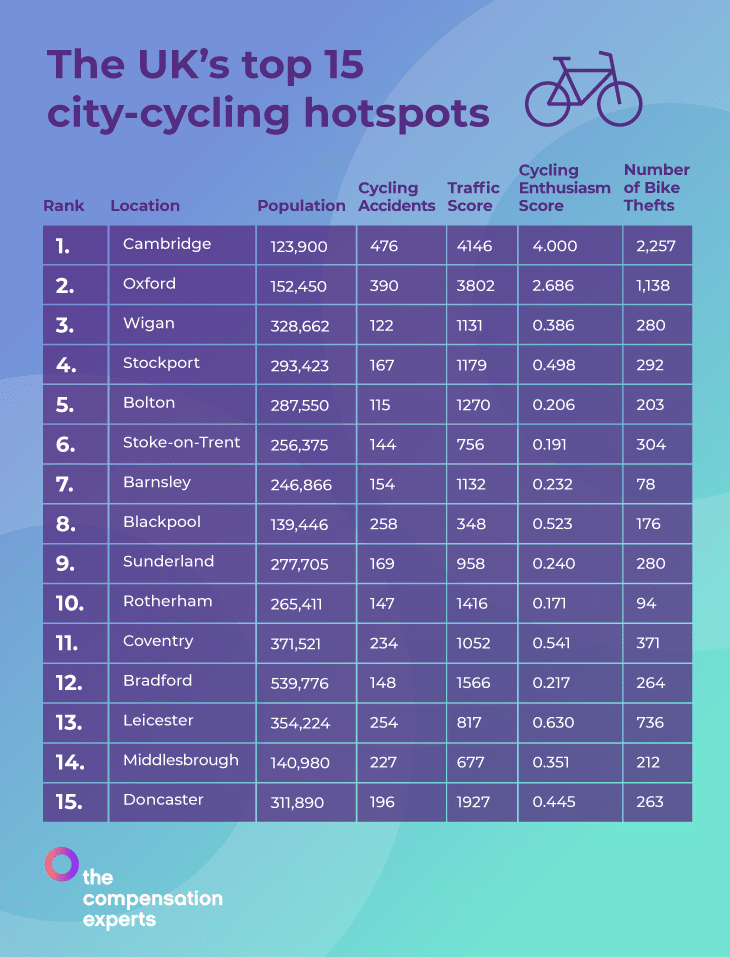
The UK’s top 15 cycling cities revealed

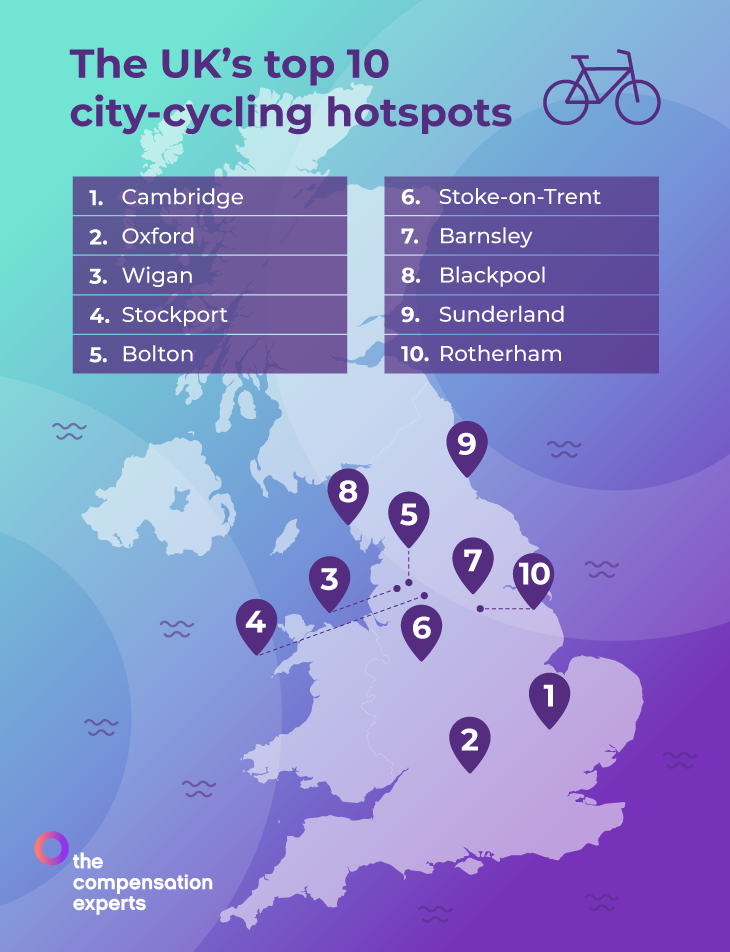
Leading the way as the UK’s top city for cycling, Cambridge comes away with an impressive index score of 3.248 out of 4.000. This is helped, in part, by the city outranking all other UK locations for cycling enthusiasm, far ahead Oxford and York who take second and third, respectively, for this category.

Oxford is also the overall runner up, placing as the second-best city across the UK for cycling, with an index score of 3.078. Next up, there’s clearly a cycling hub in the North-West, with Wigan (2.996), Stockport (2.965), and Bolton (2.953) each claiming places in the top five. In fact, Bolton and Wigan are also statistically the safest two towns to ride your bike, seeing fewer road accidents involving a cyclist than anywhere else in the UK.

Meanwhile, Stoke-on-Trent claims sixth on the list, with an overall index score of 2.936, followed by the South Yorkshire town of Barnsley (2.924). Interestingly, Barnsley is also the UK location that records the fewest bike thefts, followed by Rotherham and Plymouth.

In eighth, we head to the Lancashire coast and the seaside town of Blackpool, which comes in with an overall index score of 2.909, helped along the way by also being the place with the lowest amount of static or slow-moving traffic in the UK. Placing ninth, by the slimmest of margins, we have the northeast of England’s first representation, with Sunderland achieving an index score of 2.908, while Rotherham (2.900) takes tenth.

In 11th, we have Coventry (2.897), followed by West Yorkshire’s best cycling city in Bradford (2.896), which beats neighbouring Leeds considerably (placing 32nd nationwide). Rounding up the top 15 towns and cities for cycling, our index places Leicester (2.893) in 13th, Middlesbrough (2.883) in 14th, and Doncaster (2.876) in 15th.

Notably, London ranks lowest across each of our indexed cities, because of the intense city-wide traffic and high number of bike thefts (over ten times that of number one ranked Cambridge). Curiously, the cities of Hull, York, Bristol, and Brighton see more cycling accidents than any other, including the Capital.

Methodology

To index and rank each city, we first had to collect relevant cycling data, including the average cycling casualties per city, a city’s traffic rate, the cycling enthusiasm across the town and its people, and the recorded number of bike thefts within the area. 

After gathering the above data, we ordered each city for each category and assigned a score between 0.000-1.000 depending on position. To give a final index total, we combined all four category scores, giving an overall figure between 0.000-4.000. We then ordered each city, depending on its final index score to give us our top 15.

Cycling is a great way to exercise, socialise, and enjoy competition, and with countless beautiful routes running through the nation’s towns, cities, and countryside, the UK really is a biking haven. For even more interesting insight and the latest in our world, head on over to our blog.

Dogs are the UK’s most popular choice of pet. Around 8.5 million of them happily live with families, and never do anything more aggressive than terrorise your slippers. Unfortunately, the number of dangerous dogs is rising and with it the number of dog attacks. There was a 75% rise of dog attacks in the past decade.

Dog Attacks

Claiming for Dog Attacks

Dog bites can cause both physical and psychological scars, including a lifelong fear of dogs. Children are particularly vulnerable; around 20% of all people who seek medical attention for a dog bite are under nine years old. You can claim compensation after a wound received from a stranger’s dog, or a working dog like a police dog.

Under the Dangerous Dogs Act 1991, every person who owns or looks after a dog has a legal duty to ensure the people around it are safe from attack, whether actual or threatened, in both public and private areas. So, if you or your child has been bitten by a dog, then call The Compensation Experts. We will let you know if you are entitled to claim compensation and, if so, what to do next.

In some cases, you may not even have to prove that the owner of the dog was negligent. Dangerous species that are not domesticated in the UK are under the Animal Act 1971, meaning their inherently dangerous nature makes the owner responsible for all injuries regardless.

What Steps Should You Take if You Have Been the Victim of a Dog Attack?

If you have been the victim of a dog attack, then you will need to make a police statement. This, along with medical records and witness testimonies, will help you build a solid case against the owner. It is important to note that, though you can make a claim against owners, that you might not always get compensation, as most people are not insured in this way. 

Making a Claim on Behalf of a Child

Children are some of the most common victims of dog attacks. If a child is injured due to a dog attack, then a parent or guardian may be able to make a claim on their behalf. Any compensation would go into a trust until the child turns 18.

The time limits on making a claim also differ in cases involving a child. Usually in a personal injury claim, a person has three years to make a claim. However, in cases involving a child, the time limit is longer. A parent or guardian can claim for a child until they turn 18, and then the child has until they turn 21 to make a claim for themselves.

That being said, we recommend you make a claim as soon as possible after the accident.

How We Can Help with Dog Attacks

Here at The Compensation Experts we work with solicitors who have years of experience dealing with personal injury claims. This includes dog attack claims. Contact us today by filling in our contact form. Or call us on 01614138765 to speak to one of our friendly knowledgeable advisors.

Parks have become vital to the British public during the COVID-19 pandemic. They spent a long time as many people’s only outside space, and with Love Parks Week approaching, they seem set to remain an important part of Summer 2021. However, there are always risks of public accidents in parks, and you may be unaware that if you have an accident in a park, you may be able to claim compensation.

public accidents in parks

Public Accidents in Parks

The most common type of public accidents in parks are slips, trips and falls. These accidents can happen on public footpaths in parks. They are usually caused by potholes or defects in the ground. There are certain rules when claiming for tripping on a pothole or defect in paving. On a footpath in a park, a pothole or defect must be at least an inch deep or raised.

Another cause of accidents in public parks is accidents in playgrounds. There are many causes of playground accidents. Sometimes, it is the child’s fault, or it is a by-product of playing. These are accidents that cannot be claimed for. However, if the accident was caused by faulty or unsafe playground equipment, then there may be grounds for a claim.

The main cause of accidents due to unsafe playground equipment is poorly maintained equipment. Other causes include broken equipment, poor equipment design, failure to comply to safety standards, poor layout of equipment, incorrect installation, and poor installation.

The Responsibility of Local Authorities

The Highways Act 1980 states that local authorities are responsible for keeping all roads and footpaths safe to use. Keeping all roads and pavements smooth at all times is both unnecessary and impractical. However, a council has a legal duty to repair any damage that occurs to surfaces. They must do this by making repairs within six months of being notified of the risk. If a local council does not do this and someone has an accident, then they may be liable.

If You Have Had an Accident

When you have an accident due to a defect in the footpath in a park, it is important that you take photos of the defect. This will help with your case, as it can be proof of the defect in a claim.

If you have an accident and you have information about the defect, then it can be helpful to note this down too. Details include how long the defect has been there, how often the local council repair defects, and if other people have had accidents in the same place. If the accident was previously reported, how long it took the council to fix the defect, and if they did fix it.

It is important that you report the defect to the council so that they are aware of it. They also need to be aware so that they can fix any defects.

How We Can Help with Public Accidents in Parks

Here at The Compensation Experts we work with solicitors who have years of experience dealing with personal injury claims. This includes public accidents in parks. Contact us today by filling in our contact form. Or call us on 01614138765 to speak to one of our friendly knowledgeable advisors.

When you have a road traffic accident, it can be bad enough. But if the accident was a hit and run, then it can make you feel even worse. You may not know where to turn, or if you can make a claim for hit and run accidents at all. However, The Compensation Experts are here to help.

There have been recent reports of hit and run accidents in the UK, involving both drivers and pedestrians. If you have a hit and run accident, there are certain rules you must follow. For example, you must report your accident to the police. You must do this when the accident happens, or soon after.

hit and run accidents

Motor Insurers Bureau Claims after Hit and Run Accidents

If the road accident was caused by an uninsured or untraced driver, you may still be able to make a claim. This claim is from the Motor Insurers Bureau

The Motor Insurers Bureau is an organisation that insurance companies pay into in an accident with these drivers. This would be the case if the accident was a hit and run accident. The Motor Insurers Bureau will then pay the compensation rather than the insurance company.

If you are hit by a car as a pedestrian and you did not get the details of the driver, you may also be able to make a claim for compensation from the Motor Insurers Bureau.

You can also make Motor Insurers’ Bureau claims if you have an accident involving a driver who is uninsured.

MIB Minor Injuries Claims

The Motor Insurers’ Bureau are also covered for claims following the whiplash reforms. They recently announced the launch of Official Injury Claim, a new free and official service for people who suffer road traffic accident related minor injuries, such as whiplash, to claim compensation without the need for legal representation.

Developed on behalf of the Ministry of Justice, this easy-to-use online service guides someone through the process of making a claim, obtaining a medical report, managing that claim and, if their claim is successful, receiving compensation.

They state that Official Injury Claim can be used for claims up to £5,000 for a personal injury, rising to a total of £10,000 for all losses related to the accident (such as loss of earnings and damage to your car and property).

A claim can be made if:

  • someone is aged 18 or over
  • the accident happened in England or Wales
  • the accident happened on or after the 31st May 2021
  • someone was inside a vehicle
  • someone believes the accident was not their fault

The new service has been built to make the claims process inclusive and accessible to as many people as possible.

How We Can Help with Claiming for Hit and Run Accidents

Here at The Compensation Experts we work with solicitors who have years of experience in personal injury claims. This includes hit and run accidents, and other uninsured or untraceable driver claims. Contact us today by filling in our contact form. Or call us on 01614138765 to speak to one of our friendly knowledgeable advisors.

According to recent reports, a worker had to have his arm amputated after an accident at work involving machinery. York Magistrates’ Court heard that on 25 January 2019, the worker became entangled on either the rotating workpiece or the chuck as it rotated. He sustained extensive injuries, which include a punctured lung, broken neck, fractures to the back, ribs, arm, and shoulder blade. He subsequently had his left arm amputated at the shoulder.

An investigation by the Health and Safety Executive (HSE) found that machinery standards across the site were poor. Many machines also did not have guards on them. The company received three prohibition and five improvement notices. These included machine guarding, welfare, and management issues.

The company pleaded guilty to breaching Section 2 (1) of the Health & Safety at Work etc Act 1974. They had to pay a fine of £60,000 and costs of £7,618.

Speaking after the hearing, an HSE inspector said: “Entanglement incidents on unguarded rotating machinery are far too common. The worker’s injuries were life changing and he also could have easily been killed. The company could have avoided this serious incident and devastation if basic safeguards, risk assessments, supervision and instruction were in place.”

accident at work involving machinery

Accidents at Work Involving Machinery

Accidents at work involving machinery can be very serious. Machinery must adhere to a certain standard so that it is safe to use, and your employer must conduct regular checks and tests to prevent machine accidents.

Your employer has to ensure that machinery is safe to use. There are regulations in place to ensure that your employer keeps the machinery safe and keeps the staff safe from machinery injuries.

In the accident where the worker was injured, the machine did not have a guard on it. Therefore, this means that the machinery did not adhere to the Provision and Use of Work Equipment Regulations 1998 (PUWER).

In these regulations, employers must make sure that machinery is safe to use and also fit for purpose. This includes:

  • Taking appropriate hardware measures – providing suitable guards, protection devices, warning devices, emergency stop buttons and other system control devices
  • Taking appropriate software measures – ensuring maintenance is only performed when equipment is shut down, providing adequate instruction, information, and training about the equipment, and following safe systems of work
  • Ensuring the equipment is suitable for use, maintained in a safe condition for use, and regularly inspected

If your employer fails to do any of this, then they may be at fault for the accident, and you may be able to claim compensation. This was the case with the accident at work involving machinery and the worker who had to have his arm amputated.

How We Can Help

Here at The Compensation Experts we work with solicitors who have years of experience in personal injury claims. This includes an accident at work involving machinery. So contact us today by filling in our contact form. Or call us on 01614138765 to speak to one of our friendly knowledgeable advisors.

Deafblindness is far more common than many people realise; around 400,000 people are affected by sight and hearing loss in the UK. Deafblindness is the loss of sight and hearing to the point where your communication, mobility, and ability to access information are impacted. This includes ‘progressive’ sight and hearing loss, where your sight and hearing may deteriorate over a period. Deafblindness is often also referred to as ‘dual sensory loss’ or ‘dual sensory impairment’. Accidents that cause deafblindness are likely to cause serious injuries.

Accidents that Cause Deafblindness

One of the most common types of injury that can cause deafblindness is head or brain injury. There are many causes of head injury. These include accidents at work, road traffic accidents as a driver, cyclist, motorcyclist, or pedestrian, and falling from height.

After an accident that causes deafblindness, you will almost certainly have to make drastic changes to your life. You may need modifications to your home, or may even have to move into assisted living, you may also have to give up both work and driving, and you may need assistance from a carer to complete day-to-day activities.

Accidents that cause deafblindness

Serious Injury Claims

Serious injuries can have a catastrophic effect on a person’s quality of life. Examples include brain injury, spinal cord injury, amputation, severe burns and blindness.

Anyone who sustains a serious injury will be facing a less-independent future in which they will require expert care and support. On a practical level, they may have to change jobs or give up work altogether which can place a strain on their finances. You may need specialist equipment such as wheelchairs, prosthetics or visual aids and you may need to make modifications to your home. Some injured persons will require 24-hour ongoing support.

No amount of compensation can reverse the impact of a serious injury but it can cover the cost of rehabilitation. Our panel of serious injury claims solicitors are on hand to ensure that you get all the care and support you need.

Claiming Compensation for Accidents that Cause Deafblindness

No two injuries are the same, therefore there is no one answer to how much compensation you could claim for an accident that causes deafblindness. However, there are guidelines that indicate how much you could potentially claim. These are the Judicial College Guidelines, and they estimate how much someone may be able to claim for injuries. The Judicial College Guidelines state that, for an accident that causes deafblindness, you could claim in the region of £322,060.

Claiming on behalf of someone else

If a loved one suffers an accident that causes deafblindness, they may be unable to make a claim for themselves. If a loved one is dependent on you, then you may be able to claim compensation on their behalf. The person who makes the claim on behalf of the injured person must be their next-of-kin.

How We Can Help

Here at The Compensation Experts we work with solicitors who have years of experience dealing with personal injury claims. This includes accidents that cause deafblindness. So contact us today by filling in our contact form. Or call us on 01614138765 to speak to one of our friendly knowledgeable advisors.

They’re meant to be a fun and eco-friendly way to get around cities – and e-scooters are a big hit in the UK. E-scooter trials are currently ongoing in 32 areas across the UK, in everywhere from Somerset to Sunderland, and Halfords have reported a 184% rise in sales year on year. We’ve reported before about how UK law prohibits the use of privately-owned electric scooters on pavements and public roads, but these electronic vehicles are still prevalent across UK towns and cities.

As more and more cities embrace e-scooter trials, there have been a rising number of e-scooter accidents, often with tragic and fatal outcomes – so are Brits worried about the rise of e-scooters? To find out what the public really think, we surveyed 1500 Brits over the age of 18 to reveal their thoughts and opinions on e-scooters, and the results are telling.

Almost half of Brits (47%) don’t think that e-scooters are safe, and 60% of people think that they will cause more accidents. There are lots of concerns about the future of e-scooters, and the issues they could cause – find out what our research revealed about Brits’ thoughts on e-scooters.

E-Scooter speed limits

Rental e-scooters trials across the country have a maximum speed of 15.5mph, but the most powerful privately-owned e-scooters can reach speeds of up to 68mph – which perhaps explains why a significant 76% of Brits think we need to impose a speed limit on e-scooters. 60% of Brits also think e-scooters are more dangerous than bicycles, perhaps because average cycling speeds in the UK are between 12-15mph – well below the high speeds a privately-owned e-scooter can reach.

E-scooter licenses and tests

It remains effectively illegal to use a privately-owned e-scooter on any public road, pavement, cycle lane or in a public space, and they can only legally be used on private land. Nevertheless, e-scooters are still sold on the high street and online, and the lack of oversight may explain why 70% of Brits think E-scooters should be regulated by the government.

Though you do need a license to drive an e-scooter from an official trial, a provisional license gives you the license needed to drive an e-scooter – no test needed. Given the lack of oversight, and the potential danger of e-scooters on roads, it’s not surprising that 64% of Brits think that there should be a test before you can ride an e-scooter.

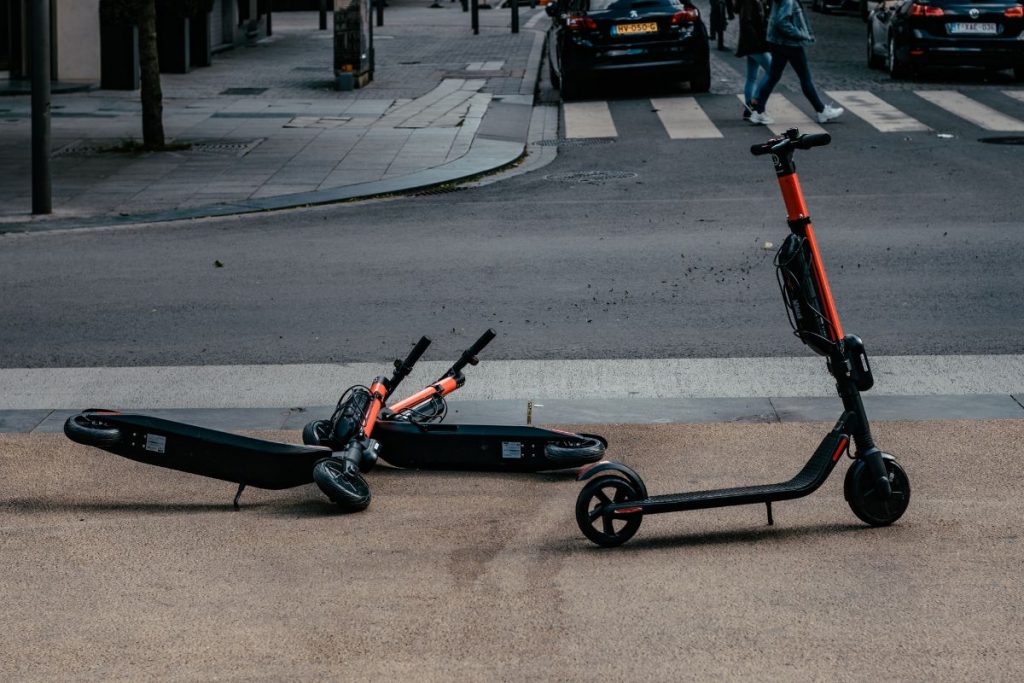
An e-scooter left on the street as part of a public trial.

Do e-scooters pose a danger to pedestrians?

While e-scooters are illegal to use on pavements, nevertheless, our survey revealed that Brits still have major safety concerns about the risk of pedestrian accidents. The majority of Brits (56%) don’t feel safe walking down the high street with e-scooters, and three-quarters (74%) of Brits don’t think e-scooters should ever be allowed on pedestrian paths.

One of the benefits of e-scooters is their eco-friendly nature – but their electronic motor, which is great for the environment, means that they run very quietly as well as very quickly, which is a real potential hazard for pedestrians. In particular, there are concerns about the impact on people with disabilities, especially as lots of e-scooters are illegally used on pavements which are already full of potential hazards for anyone with mobility issues, partial sightedness or a hearing impairment.

In fact, the Royal National Institute of Blind People have openly expressed concerns about e-scooter trials across the country. Even with the 15.5mph speed limit, they consider e-scooters to be a “real and genuine threat to the ability of blind and partially sighted people to move around independently and safely”. The British public overwhelmingly agree – 73% of Brits think that e-scooters should have audio warnings for people with disabilities.

It shouldn’t be overlooked that using e-scooters unsafely and illegally also poses a huge risk to the driver – there have been an unfortunate amount of fatal accidents for people driving e-scooters on busy roads. While the Met Police recommend that helmets should be worn while riding an e-scooter, this isn’t enshrined in law in the same way it is for motorcyclists. But 81.48% of Brits think you should have to wear a helmet when riding an e-scooter, to protect drivers from serious harm.

Views on e-scooters across the UK

Despite more than thirty ongoing trials of e-scooters in UK towns and cities, half of Brits think e-scooters should not be allowed in city centres, and the cautions and concerns are clear to see in places where e-scooter trials are taking place.

In the cities where e-scooter trials are underway, there’s a lot of public caution – 61% of people in Nottingham believe that e-scooters should be government regulated. Liverpool, allows e-scooter hire for £1 unlocking fee, plus a 20p per minute fee – and though the carbon-neutral scooters are capped at speeds of 10mph, with an extra cap of 5mph in busy areas, the sight of e-scooters on the road seems to have instilled a sense of caution in Liverpudlians: 80% pf people in Liverpool think you should wear a helmet riding an e-scooter.

It’s a similar story in London, which launched its own e-scooter trial in June 2021, but has seen plenty of e-scooters illegally driven on roads around the capital. The Daily Mail reports Met Police officers recently seized more than 100 e-scooters that had been driven illegally, contributing to serious injuries to riders and pedestrians. Perhaps it’s not surprising that three quarters of people in London think that there should be a speed limit imposed on all e-scooters.

Top tips for staying safe on e-scooters

Whether you’re using a public trial e-scooter or a privately-owned e-scooter on private property, you should always follow some basic safety tips. Here’s how to make sure you stay safe when riding an e-scooter.

1. Keep both hands on the handlebars at all times

It’s easy to get overconfident on an e-scooter. If you get a notification, it’s tempting to take a hand off the wheel and glance at your phone screen – but taking a hand off the handlebars can change your balance point, and easily lead to accidents!

2. Always wear protective equipment

It’s easy to think that because public trial e-scooters don’t go above 15mph, you won’t need protective equipment. But you can’t control other drivers, or account for human error on busy roads. You should always wear a helmet at the very least – it could be the difference between life and death.

3. Inspect your scooter before you ride

You should always check the battery, tire pressure, and brakes every time you hop on an e-scooter. Running out of charge at a busy intersection or riding on underinflated tires could cause a serious accident.

4. Don’t double up on an e-scooter

E-scooters are made for one person – there’s not enough room on standard electric scooters for two people, but that doesn’t stop people from riding tandem. E-scooters have a set weight limit, so if you’re over that limit and crash, you’re likely to be liable!

How can we help?

E-scooters are clearly a concern for the British public, and as their popularity continues to rise, pedestrians and motorists across the UK will continue to have plenty of apprehensions about their safety. We are experts in personal injury compensation and road traffic accidents, so if you’ve been involved in an accident with an e-scooter, get in touch for expert advice and find out how we can help you get the compensation you deserve. For more of the latest guidance and information, head to our blog for more news